Category: Investment Grade Weekly

20 Mar 2020

Corporate Bond Market Update

It was a difficult week for the Corporate Bond market as fear and uncertainty related to COVID-19, a precipitous drop in oil, and an inter-meeting rate cut by the U.S. Federal Reserve drove Treasuries lower and spreads wider.

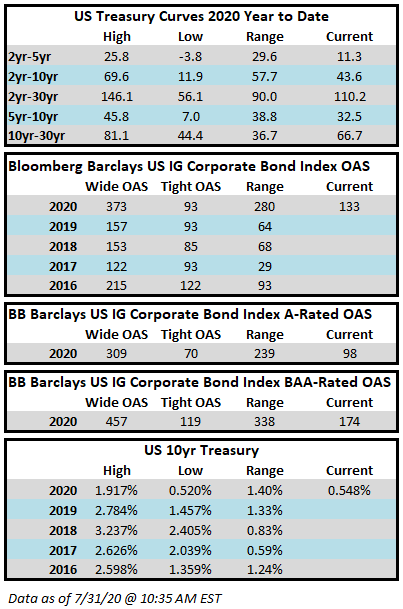
When we look at the Investment Grade market the option adjusted spread on the Bloomberg Barclays US Corporate Index was 122 at month-end February 2020, while on Friday, March 13, 2020 it closed at 216. This was one of the quickest and most volatile spread moves in the history of the investment grade credit market.

(Source: Bloomberg)

There was a corresponding move lower in Treasuries across the board – this helped to mitigate some, but not all, of the impact of widening spreads.

(Source: Bloomberg)

To provide some context on the performance of the investment grade credit market, through the end of the day on Friday March 13, the Bloomberg Barclays US Corporate Index posted a YTD gross total return of -1.88%. Comparatively, the S&P 500 YTD gross total return was -15.73% (Source: Bloomberg). While we are not happy to see negative returns in the corporate bond market, the asset class has performed as expected during a period of extreme volatility, and it has held up materially better than equities and other risk assets.

CAM does not provide intra-monthly performance figures, however as of March 13, 2020 we note that CAM’s portfolio has the following defensive characteristics relative to the Index. CAM is significantly underweight in BBB rated corporate credit relative to the Index. CAM caps its exposure to BBB-rated credit at 30% while the Corporate Index’s exposure was 49.14% as of March 13. Interestingly, the BBB concentration of the Index is down slightly YTD but that is merely because some large issuers, like Kraft-Heinz, were downgraded from BBB to junk status – an example of the type of investment CAM seeks to avoid through its bottom up research process. The second and third major factors that will impact CAM’s performance relative to the Index relate to individual credit selection and avoidance of certain industries which have been particularly hard hit by COVID-19, such as Leisure. To be sure, we have individual credits within our portfolio that have been affected by both COVID-19 and the decline in the oil market and we are constantly monitoring and evaluating those situations through active management of the portfolio.

It was also an exceptionally difficult week for the High Yield market with a one-two punch of fear and uncertainty related to COVID-19 as well as a complete flush of the oil market due to the lack of an OPEC agreement. The option adjusted spread on the Bloomberg Barclays US Corporate High Yield Index spiked above 700 for the first time since the commodity fueled rout of 2016. The Index YTD gross total return was -8.84% through the end of Friday March 13 (Source: Bloomberg).

(Source: Bloomberg)

Again, CAM does not provide intra-monthly performance figures, but our High Yield portfolio has the following defensive characteristics relative to the Index. CAM had over 10% of its portfolio in cash at the start of the current sell-off in February and CAM is underweight, or zero weight, some sectors of the market that were particularly hard hit by this sell off, such as Oil Field services. To be sure, our portfolio’s gross total return was negative as of February 29, 2020, and subsequent drawdown has been widespread. We have a number of credits that have experienced increased volatility and as always we are closely monitoring those situations as well as all the credits in our portfolio. Currently, we are comfortable with the individual credit metrics of our holdings and we believe the overall portfolio is well positioned should the economy enter a recessionary environment. Our cash balance also affords us the ability to be opportunistic on behalf of our clients as those situations arise.

The High Yield market can be extremely volatile in times of stress. It is not as deep or as liquid as the Investment Grade credit market and that is one of the reasons that spreads can gap wider so quickly. The growth of ETFs has exacerbated this problem as they are often forced to sell in the face of investor liquidations. We would caution that during times like these it can be difficult to achieve favorable pricing when looking to sell a high yield security; and depending on your risk tolerance it can often be a good opportunity to buy. We ask that our investors continue to trust that we will professionally manage your portfolios with a long-term objective and through the extent of the current downturn to the best of our ability.

We believe it is important in times like these to remind our investors of our investment philosophy and process at CAM. While volatile markets present challenges as well as opportunities, the way we manage money remains very consistent. We are conservative investors of domestic corporate bonds with a “bottom-up value” investment discipline, stressing first and foremost the preservation of capital, with an important secondary focus on total return. We seek to deliver these results by identifying quality businesses that we are comfortable owning in all markets.

We take the responsibility of managing your money very seriously and we will always do our best to perform that task to the highest standard of care. We sympathize with our clients in uncertain times such as these and we hope that you and your families stay safe and healthy.

This information is intended solely to report on investment strategies identified by Cincinnati Asset Management. Opinions and estimates offered constitute our judgment and are subject to change without notice, as are statements of financial market trends, which are based on current market conditions. Fixed income securities may be sensitive to prevailing interest rates. When rates rise the value generally declines. High Yield bonds present risks specific to below investment grade fixed income securities. Valuation may result in uncertainties and greater volatility, less liquidity, widening credit spreads, and a lack of price transparency. Investments in fixed income securities may be affected by changes in the creditworthiness of the issuer and are subject to nonpayment of principal and interest. The value of fixed income securities also may decline because of real or perceived concerns about the issuer’s ability to make principal and interest payments. Past performance is not a guarantee of future results. Gross of advisory fee performance does not reflect the deduction of investment advisory fees. Our advisory fees are disclosed in Form ADV Part 2A. Accounts managed through brokerage firm programs usually will include additional fees. Returns are calculated monthly in U.S. dollars and include reinvestment of dividends and interest. The Index is unmanaged and does not take into account fees, expenses, and transaction costs. It is shown for comparative purposes and is based on information generally available to the public from sources believed to be reliable. No representation is made to its accuracy or completeness.

The information provided in this report should not be considered a recommendation to purchase or sell any particular security. There is no assurance that any securities discussed herein will remain in an account’s portfolio at the time you receive this report or that securities sold have not been repurchased. The securities discussed do not represent an account’s entire portfolio and in the aggregate may represent only a small percentage of an account’s portfolio holdings. It should not be assumed that any of the securities transactions or holdings discussed were or will prove to be profitable, or that the investment decisions we make in the future will be profitable or will equal the investment performance of the securities discussed herein.

21 Feb 2020

CAM Investment Grade Weekly Insights

Corporate credit spreads were wider across the board this week but lower Treasury rates were the bigger story and more than offset the move wider in spreads.  After closing the week prior at a spread of 96, the Bloomberg Barclays Corporate Index closed Thursday evening at a spread of 97, but spreads are weak and drifting wider as we go to print on Friday morning.  Global risk markets are skittish among renewed fears that coronavirus may not be adequately contained.  Frankly, we are a bit mystified at how easily markets dismissed virus fears to this point.  It is not so much the virus itself but the fact that the second largest economy in the world has been closed for business for the better part of a month.  This has serious consequences for growth across the globe due to the interconnected nature of the global economy.  Treasuries were volatile over the course of the past week.  The 10yr closed at 1.58% last Friday and it is wrapped around 1.45% as we go to print, coincident with its lowest levels of 2019.  Meanwhile, the 30yr Treasury fell as much as 7 basis points on Friday morning to an all-time low of 1.89%.


The primary market had a very solid week especially considering it was shortened by one day due to a market holiday on Monday.  Weekly issuance topped $35bln pushing the month-to-date total north of $86bln.  Year-to-date issuance is now closing in on $220bln which is ahead of 2019’s pace by more than +23% according to data compiled by Bloomberg.  Issuance is off to a strong start in 2020 but we would expect this pace to slow in the second half of the year as the presidential election approaches.

According to Wells Fargo, IG fund flows during the week of February 13-19 were +$7.4bln.  This marks one of the strongest starts to a year on record.  Year-to-date IG fund flows have now eclipsed $71bln.


07 Feb 2020

CAM Investment Grade Weekly Insights

Spreads for corporate credit were generally tighter on the week.  After closing the week prior at a spread of 102, the Bloomberg Barclays Corporate Index closed Thursday evening at a spread of 96.  The tone at mid-day Friday is mixed as risk markets continue to weigh the impact of coronavirus.  Treasuries were volatile over the course of the past week.  The 10yr closed at 1.51% last Friday which was its lowest level of the year.  The benchmark rate then closed as high as 1.65% this Wednesday and is now fluttering around 1.58% on Friday afternoon.


The primary market had a fair week as corporate borrowers issued over $21bln in new debt.   2020 issuance has eclipsed $154bln according to data compiled by Bloomberg.

According to Wells Fargo, IG fund flows during the week of January 30-February 5 were +$9.0bln making it the largest 5-week total for fund flows on record.  This brings year-to-date IG fund flows to over $36bln.  Both domestic and global investors continue to favor U.S. credit markets as one of the last bastions for reasonably safe yield.

24 Jan 2020

CAM Investment Grade Weekly Insights

Spreads drifted 2 basis points wider on the week with the OAS on the corporate index moving from 93 to 95.  Fears of a global health crisis drove Treasuries to 2020 lows and the 10yr is currently trading at 1.698% as we go to print, its lowest level of 2020.

It was another solid week for the primary market as over $25bln in new debt was priced.   January issuance has now topped $123bln which is up 46% relative to 2019’s pace according to data compiled by Bloomberg.  New deals of all stripes have been well oversubscribed and while there were still new issue concessions available they were quite slim, typically just a few basis points.

According to Wells Fargo, IG fund flows during the week of January 16-22 were +$4.8bln.  This brings year-to-date IG fund flows to over $20bln.  This is the third consecutive week of strong inflows into the IG credit market.


(Bloomberg) Delayed Disclosure of Biggest Corporate Bond Trades Stalls

  • S. regulators have halted a plan to test whether delayed disclosure of corporate bond trades would boost market liquidity after a powerful group of investors, including Vanguard Group Inc., Citadel and AQR Capital Management, slammed the proposal.
  • A Wall Street trade group informed its members late last year that the Financial Industry Regulatory Authority’s controversial plan had been put on hold, said two people familiar with the matter. The brokerage watchdog could still make changes and go forward after consulting with the Securities and Exchange Commission, another person said.
  • Finra’s plan was to review the impact of giving traders two full days before having to reveal so-called block trades — the largest transactions. Some of the biggest money managers, such as Pacific Investment Management Co. and BlackRock Inc., have argued that a requirement that block trades be reported within 15 minutes has made it harder for banks to profit from facilitating buying and selling. That has prompted Wall Street securities firms to retrench, making it harder for buy-side participants to execute trades.
  • Finra first proposed its study in April 2019 and gave the public until June 11 of last year to provide feedback. The regulator has said little about the test in the seven months since the comment period expired.
  • Corporate bond trades are revealed through Finra’s Trade Reporting and Compliance Engine, better known as Trace. The regulator introduced the system in 2002 with the goal of increasing transparency, as most transactions have historically taken place over the phone between buyers and sellers.
  • A common refrain among Wall Street banks is that rules passed in the wake of the 2008 financial crisis made it harder and more expensive for them to hold large inventories of corporate bonds. That has prompted banks to function mostly as intermediaries that link up buyers and sellers, rather than purchasing big blocks of bonds from investors and then unloading the debt over time for a profit.
  • Vanguard disputes those claims. In its letter, the asset-management giant said there’s no proof that prompt disclosure of trades is hurting liquidity. But it is clear, according to Vanguard, that increased transparency lowers transaction costs. It called the proposed study “a harmful solution to an unsubstantiated problem.”


(Bloomberg) Investors Just Keep Pumping Cash Into Corporate Bond Funds

  • Credit bond funds continue to rake in cash as investor appetite for risk remains voracious.
  • Buyers pushed $4.2 billion into high-grade funds for the week ended Jan. 22, according to Refinitiv Lipper. That’s on top of last week’s $6.6 billion influx and a record $8.2 billion inflow from the prior reporting period.
  • This month’s sum covering the first three weeks of the year — a whopping $19 billion — already exceeds last year’s full-month January inflow total by about $5 billion.
  • Seemingly insatiable demand has kept the high-grade primary market hot as some new bond deals come in as much as seven times oversubscribed and secondary spreads stand at the tightest level since February 2018.


17 Jan 2020

CAM Investment Grade Weekly Insights

It was another busy week in the corporate credit markets; inflows remained robust, the new issue calendar continued to hum and the secondary market featured buyers grabbing for yield.  Risk markets have been incredibly resilient as they have shrugged off geopolitical turmoil and they seem to have little interest in impeachment or the upcoming presidential primaries and election.  The spread on the corporate index is one basis point tighter on the week, currently trading at 95.  The range in spreads on the index thus far in 2020 has been tight at just three basis points.


The primary market was busy again with more than $35bln in new debt coming to market on the heels of $60bln+ the week prior.  Demand was very strong as order books were well oversubscribed, even for companies with marginal credit metrics.  It is early in the year but so far new issue supply is 32% higher relative to last year, according to data compiled by Bloomberg.  Recall that CAM’s projection as well as the general consensus is calling for overall supply in 2020 to be down relative to 2019 especially on a net basis.  We expect that issuers will look to be quite active in the first half of the year and that issuance will be more subdued in the second half due to the uncertainty that typically accompanies a presidential election.  The consensus supply number for January is $120bln, according to data compiled by Bloomberg, so next week should be another solid week for issuance but will likely be somewhat lower than the previous two weeks due to earnings blackout periods.

According to Wells Fargo, IG fund flows during the week of January 9-15 were +$5.5bln.  This brings year-to-date IG fund flows to over $15.5bln, a strong start to the year.


(Bloomberg) That $1 Trillion BBB Powder Keg Worries Credit Investors Again


  • Investors raised doubts about BBB debt in late 2018, when General Electric Co. was in crisis, its bonds tanked, and investors fretted about market turmoil from mass downgrades. Those fears proved misplaced last year, when investors stampeded into BBB notes and crushed risk premiums on the securities to around their lowest level since the financial crisis. Those narrow risk premiums are what worry at least some money managers.
  • Because BBBs make up more than half the $8.4 trillion investment-grade corporate markets in both the U.S. and Europe, there’s that much more debt at risk of possibly falling to speculative grade. In 1993, BBBs were more like a quarter of the market.
  • Signs of trouble for BBB companies have started brewing this year. Italian infrastructure company Atlantia SpA lost its last remaining investment-grade rating this week, and Boeing Co.’s biggest Max supplier, Spirit AeroSystems Holdings Inc., has also fallen into junk.
  • Some money managers are focusing on finding bargains among BBB notes. Many of the largest BBB constituents gorged on debt to fund M&A, bringing their total obligations in 2018 to around $1 trillion, according to a Bloomberg analysis. Some of those companies have put debt reduction at the forefront, selling assets and cutting dividends to free up cash. That helped make GE, AT&T and AB InBev among 2019’s best corporate bond investments.


20 Dec 2019

CAM Investment Grade Weekly Insights

Another week has come and gone and corporate bonds continue to inch tighter into year end.  The OAS on the Bloomberg Barclays Corporate Index opened the week at 99 and closed at 95 on Thursday.  Spreads are now at their tightest levels of 2019 and the narrowest since February of 2018 when the OAS on the index closed as low as 85.  Price action in rates was relatively muted during the week amid low volumes but Treasuries are set to finish the week a few basis points higher.  The 10yr opened the week at 1.87% and is trading at 1.91% as we go to print.

As expected, the primary market during the week was as quiet as a church mouse.  December supply stands at a paltry $18.9bln according to data compiled by Bloomberg.  2019 issuance stands at $1,110bln which trails 2018 by 4%.  As we look ahead to 2020, we expect robust supply right of the gates in January but the street consensus for 2020 as a whole is that supply will be down 5% relative to 2019.  Further, net supply, which accounts for issuance less the 2020 maturity of outstanding bonds, will be down substantially from prior years.  If these forecasts come to fruition then the supply backdrop could lend technical support to credit spreads in 2020.  Supply, however, is merely one piece of the puzzle.

According to Wells Fargo, IG fund flows during the week of December 12-18 were +$0.85bln.  This brings YTD IG fund flows to +$295bln.  2019 flows are up over 11% relative to 2018.

13 Dec 2019

CAM Investment Grade Weekly Insights

The grind continues as the OAS on the Bloomberg Barclays Corporate Index breached 100 for the first time in 2019 with a 99 close on Thursday evening.  The index has not traded inside of 100 since March of 2018 and has averaged a spread of 127 over the past 5-years and 113 over the past 3-years.  Treasuries were again volatile on the week, especially Friday, which saw a range of 15 basis points on the 10yr Treasury.  However, as we type this during the late afternoon on Friday it appears that the 10yr is going to end the week almost entirely unchanged from the prior weeks close.

The primary market has entered year-end Holiday mode. Less than $4bln in new debt was brought to market during the week.   The first half of next week is the last chance for meaningful issuance in the month of December.  According to data compiled by Bloomberg, 2019 issuance stands at $1,110bln which trails 2018 by 4%.

According to Wells Fargo, IG fund flows during the week of December 5-11 were +$5.4bln.  This brings YTD IG fund flows to +$282bln.  2019 flows are up over 10% relative to 2018.


15 Nov 2019

CAM Investment Grade Weekly Insights

Credit spreads are set to finish the week generally unchanged but may be a touch wider in some spots when it is all said and done.  The spread on the Bloomberg Barclays Corporate Index opened the holiday shortened week at 105 and closed at 106 on Thursday.  There is positive sentiment in the markets on Friday morning amid China-US trade innuendo out of Washington.  For the second week in a row we have seen a relatively significant move in treasuries; last week it was higher rates and this week lower.  The 10yr Treasury closed the prior week at 1.94% and is now 1.83%, 11 basis points lower on the week as we go to print.

The primary market posted an impressive haul this week, especially considering the fact that the market was closed on Monday.  It was the second largest volume week of the year thanks to a big boost from AbbVie, which printed a $30bln deal that featured 10 different maturities.  With one deal pending this morning, weekly issuance will come in at the $50bln mark.  Oddly enough both the largest and second largest issuance weeks in 2019 have both come on holiday shortened weeks.  The largest volume week was the week of Labor Day when nearly $75bln of new debt was priced in just four days. According to data compiled by Bloomberg, 2019 issuance stands at $1,065bln which trails 2018 by -4.4%.

According to Wells Fargo, IG fund flows during the week of November 7-November 13 were +$2.8bln.  This brings YTD IG fund flows to +$252bln.  2019 flows are up 9.5% relative to 2018.


Bloomberg) AbbVie Propels High-Grade Issuance to Year’s Second-Biggest Week

  • It’s the second-biggest week of the year for U.S. investment-grade issuance, which at about $50 billion in volume trails only the record-setting start to September.
    • AbbVie’s $30 billion deal on Tuesday clocked in as the year’s largest bond sale and the fourth-biggest ever, helping to establish this week’s second-place finish
      • Supply for the week stands at $49.4 billion as of Thursday with more deals potentially coming Friday given a shorter window to sell debt after Monday’s Veteran Day close
      • The first week of September saw $75 billion of high-grade bond sales, the most for any comparable period since records began in 1972
      • This week overtook the five days to May 9, when IBM and Bristol Myers brought $39 billion in acquisition-related supply in a 24-hour span


(Bloomberg) Here’s How KKR Might Just Pull Off the Biggest LBO in History

  • One of the private equity industry’s titans called it a “stretch,” and it’s been dismissed as a pipe dream by a bevy of analysts.
  • Yet interviews in recent days with debt-market specialists suggest that KKR & Co. could find a narrow path to finance what would be the biggest leveraged buyout in history: a potential take-private deal for pharmacy chain Walgreens Boots Alliance Inc. that analysts have estimated would need to be funded with at least $50 billion of debt.
  • The challenge for any Walgreens suitor will be raising the necessary money via the markets of choice for private equity firms — junk-rated loans and bonds — which have become fragile after an unprecedented borrowing binge left investors with a hangover. Debt funds that financed more than $3.5 trillion of leveraged buyouts in the past decade have become pickier, leaving banks stuck holding more than $2 billion of unsold loans on their balance sheets as recently as last month.
  • But a road map may be hidden in two other recent debt-fueled takeovers: Dell Technologies Inc.’s $67 billion takeover of EMC Corp. in 2016 and Charter Communications Inc.’s $78.7 billion acquisition of Time Warner Cable Inc. that same year.
  • Junk-rated Dell and Charter both borrowed heavily in the investment-grade bond market by issuing secured debt. T-Mobile US Inc. is going down a similar route to help pay for its purchase of Sprint Corp.
  • In Charter’s case, it pledged security to new and existing bonds issued by higher-rated Time Warner to ensure the debt remained investment-grade. Dell used a similar strategy when it bought investment-grade rated EMC. Walgreens’s debt could be segregated into two borrowing structures at a holding company level and an operating company portion, with investment-grade debt placed on the latter.
  • In doing so, Dell and Charter won access to the most stable part of the corporate debt market, where investors are still buying heavily as an alternative to low or negative-yielding assets elsewhere. At the same time, they limited their reliance on leveraged finance markets, where sentiment can shift quickly and prove costly.
  • Both companies did tap those markets, but with more manageable offerings. Bankers who asked not to be identified estimated that Walgreens would be able to raise between $10 billion and $20 billion of junk-rated debt to fund a buyout.
  • Other market participants, who asked not to be named because they weren’t authorized to speak publicly, said KKR still might need to find a deep-pocketed third-party investor to help put more equity into the deal.
  • Or it may seek to spin off a portion of Walgreens to lessen its financing needs. The company’s European operations could potentially bring in $18 billion to $20 billion, CreditSights analyst James Goldstein said in a phone interview.


08 Nov 2019

CAM Investment Grade Weekly Insights

Credit spreads were tighter during the week and are now at the tightest levels of 2019.  The spread on the Bloomberg Barclays Corporate Index closed at 105 on Thursday and there is a positive tone in the air on Friday morning which could lead to an even tighter close as we head into the long weekend –the bond market is closed on Monday in honor of Veteran’s Day.  The move in Treasuries during the week has more than overshadowed tighter credit spreads.  It has been a quick and violent move higher in rates.  As we go to print the 10yr Treasury is over 22 basis points higher on the week while the 30yr is 21 basis points higher.  Unpredictability in rate moves is the principal reason that we are “rate agnostic” at CAM and instead focus on credit risk while avoiding interest rate speculation by always positioning investor portfolios in intermediate maturities.

The primary market got a decent start to the month as $21.8bln in new debt came to market.  The pace should pick up substantially as soon as next week due to pending M&A funding from AbbVie which could total near $30bln. 2019 issuance has now passed the trillion dollar mark and it stands at $1,014bln which trails 2018 by -7%.

According to Wells Fargo, IG fund flows during the week of October 31-November 6 were +$3.2bln.  This brings YTD IG fund flows to +$249bln.  2019 flows are up 9.5% relative to 2018.


Bloomberg) Global Bond Sell-Off Persuades Some Investors to Buy the Dip

  • Recent losses in Treasuries, which crescendoed Thursday into one of the worst days since Donald Trump was elected president, look like a buying opportunity for many investors who have a grim view of the economy’s prospects.
  • And it appears some are pouncing, with traders cashing out bearish wagers and buy-the-dip buyers rushing in. The rekindled interest in the safety of bonds nudged yields on the 10-year, which had climbed to a three-month high of 1.97% on Thursday, down to as low as 1.89% in early European trading Friday before bouncing back to around 1.94%. European bonds rebounded after French and Belgian yields had climbed above 0% Thursday.
  • Signs of progress in U.S.-China trade talks have thrashed bonds for days, and the two countries agreed Thursday to roll back tariffs on each other’s goods if a deal is reached. The Treasury market has seen a huge turnaround since August, when fears that global growth is slowing prompted the biggest monthly rally since 2008.


(Bloomberg) U.S. Says Phase-One China Deal Would Include Tariff Rollback

  • The U.S. and China have agreed to roll back tariffs on each other’s goods in stages as negotiations continue over resolving the more than yearlong trade war, officials on both sides said.
  • “In the past two weeks, top negotiators had serious, constructive discussions and agreed to remove the additional tariffs in phases as progress is made on the agreement,” China’s Ministry of Commerce spokesman Gao Feng said Thursday.
  • White House economic adviser Larry Kudlow confirmed the advance in negotiations. “If there’s a phase one trade deal, there are going to be tariff agreements and concessions,” he told Bloomberg.
  • An agreement to ratchet back tariffs would pave the way for a de-escalation in the trade war that’s cast a shadow over the world economy. China’s key demand since the start of negotiations has been the removal of punitive tariffs imposed by Trump, which by now apply to the majority of its exports to the U.S.
  • “If China, U.S. reach a phase-one deal, both sides should roll back existing additional tariffs in the same proportion simultaneously based on the content of the agreement, which is an important condition for reaching the agreement,” Gao said Thursday.
01 Nov 2019

CAM Investment Grade Weekly Insights

Credit spreads were turbulent during the week.  The first half of the week saw tighter spreads, and the OAS on the Corporate Index closed at 106 on Tuesday, the tightest level of 2019.  Spreads traded wider from there on the back of Fed commentary on Wednesday which was followed by a surprisingly weak Chicago PMI reading on Thursday morning leading to a close of 110 for the index on Hallows eve.  The economic news continued to roll in on Friday morning, but this time it was received in positive fashion as employment numbers beat market expectations.  As we go to print amid lighter volumes in corporates most bonds are trading 2-4 tighter which should see the index close right around 108.  If we do close at 108 then spreads will have finished the week unchanged.  Rates too were volatile during the week with the 10yr closing at 1.84% on Monday but it is now trading at 1.73% on Friday afternoon.  This is lower on the week, as the 10yr finished the week prior at 1.79%.

The primary market was somewhat more active this week but finished the month well shy of expectations.  October volume closed at $68.6bln versus dealer projections of $85bln according to data compiled by Bloomberg.  2019 issuance stands at $992bln which trails 2018 to the tune of -6%.

Demand for corporate credit continues to remain robust.  According to Wells Fargo, IG fund flows during the week of October 24-30 were +$4.2bln.  This brings YTD IG fund flows to +$246bln.  2019 flows are up over 9% relative to 2018.


(Bloomberg) Credit Risk Gauge Drops to Six-Week Low on Bullish Jobs Report

  • Investors pushed the cost to protect a basket of investment-grade company debt against default to the lowest level since Sept. 19 following the unexpectedly strong U.S. jobs report on Friday.
    • The Market CDX Investment Grade index spread fell as much as 2 bps to touch 52.96 bps Friday morning in New York before paring some of the gains to trade at 53.67 bps at 12:30 p.m, according to ICE Data Services. The index narrowed by the most in almost three weeks, data compiled by Bloomberg show.
    • Excess demand for higher-quality bonds and low supply have propelled gains in corporate investment-grade markets. October new IG issues ended at $68.6 billion, falling short of the $85 billion dealer projections by nearly 20%, while cash continues to flow intohigh-grade bond funds.


(Bloomberg) Riskiest Junk Debt Still Isn’t Cheap Enough to Lure Buyers

  • Notes rated in the CCC tier, essentially the lowest level in the junk bond market, have grown cheaper since May even as most of the market has grown stronger. Risk premiums, or spreads, on the debt are close to their widest level relative to the tier just above them since mid-2016, according to data compiled by Bloomberg.
  • The weaker performance of the lowest-rated debt underscores how even as investors are reaching for higher returns as the Federal Reserve eases interest rates, they’re still wary of a potential economic downturn and fear that defaults could start to tick higher. The highest tier of junk bonds have gained 13.5% this year, and overall high-yield corporate bonds are up 11.9%, while those rated CCC have gained just 5.7%.
  • CCC debt doesn’t usually perform like this. Because the companies that sell the notes are already so close to defaulting, CCC bonds are typically hit harder than the broad market during a market downdraft. When the market recovers, the securities often perform much better. The debt plunged in early 2016 when energy prices dropped, but went on to notch huge returns for the year — 31.5% to the broader market’s 17.1% — as oil prices started recovering.

This year, CCC bonds are performing worse than the market even as the overall supply of the lowest-rated notes has been shrinking. There are about $156 billion of those bonds outstanding today, down from $167 billion in February. So far this year, CCC rated companies have sold around $24 billion of debt, less than the same period for each of the previous two years, according to data compiled by Bloomberg.


Bloomberg) Top Fed Officials Hammer Home Message That Rates Are on Hold

  • Federal Reserve Vice Chairman Richard Clarida reinforced the central bank’s new message this week that interest rates are on hold, saying that both monetary policy and the U.S. economy are “in a good place,” though some risks remain.
  • “We have a favorable outlook for the economy,” Clarida said Friday in an interview with Jonathan Ferro and Tom Keene on Bloomberg Television. “We think the economy is in a good place, we think monetary policy is in a good place.”
  • He repeated that message in a lunchtime speech at the Japan Society in New York, with Fed Vice Chairman for Supervision Randal Quarles delivering a similar signal at an event at the same time at Yale University in New Haven, Connecticut.
  • The vice chairs’ overlapping remarks hewed closely to what Chairman Jerome Powell said earlier this week after the Fed cut rates for a third time this year, signifying a strong consensus at least among the Board of Governors. The Fed has acted to protect a record U.S. economic expansion amid headwinds from trade uncertainty and global weakness, while the domestic economy has been holding up.