Fund Flows & Issuance: According to a Wells Fargo report, flows week to date were $0.0 billion and year to date flows stand at -$34.0 billion. New issuance for the week was $0.0 billion and year to date HY is at $131.2 billion, which is -24% over the same period last year.
(Bloomberg) High Yield Market Highlights
- The U.S. junk bond primary market seems closed for business for the rest of August, as is typical for this time of year since at least 2014. No no issues were priced this week for the third time in 2018. This has been the slowest August since at least 2015, with just $14.7b pricing.
- Yields dropped for five straight sessions across ratings and spreads tightened amid light trading
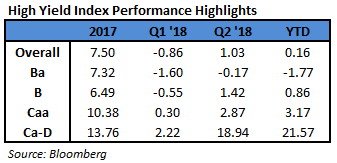
- CCCs continued to beat BBs and single-Bs, BB returns turned positive this week for the first time in seven months
- CCCs were on top with a YTD return of 4.51%
- Investment- grade bonds were down 1.55% YTD
(USA Today) U.S. prison strike prompts solidarity rallies
- A nationwide prison strike is ongoing, and while there’s no official count of the number of inmates who have acted thus far, solidarity rallies have popped up across the U.S. in an attempt to pressure the nation’s criminal justice system.
- The goal of protesters is to put an end to what organizers refer to as “modern-day slavery,” a practice where inmates are paid slave wages for labor. Such is the case in California, where prisoners are assisting in efforts to fight wildfires and being paid as little as $2 per day.
- “I think the outcome is likely to be greater public awareness about the difficult and inhumane conditions that many prisoners face across the country – an elevated public attention to the broad issues as well as some of the more specific concerns that prisoners themselves have raised,” said Toussaint Losier, assistant professor of Afro-American Studies at the University of Massachusetts and author of “Rethinking the American Prison Movement.”
- While inmates inside detention centers peacefully protest, activists outside of the penal system are working to raise awareness by holding rallies in various city squares and outside correctional facilities.
- The demands, a total of 10, were arranged by the inmate-based organization Jailhouse Lawyers Speak. The demands include the immediate improvement of prison policies, an increase in prisoner wages and rescinding laws that prevent imprisoned persons from having a chance at parole.
- The inmates also are calling for more rehabilitation services and voting rights.
- The final day of the strike – Sept. 9 – also carries symbolism. That’s the day in 1971 that the Attica Prison riots began in New York, eventually leaving more than 40 people dead when police stormed in to re-take the facility.
(Bloomberg) Skittish In the Leveraged Loan Market
- For much of the past year,loan investors have been pushovers. Now, they’re showing signs of pushing back.
- Money managers have demanded better terms on a spate of deals this week, including a $1.475 billion loan for the buyout of chemicals company SI Group. Prices for the debt have fallen in August. And underwriters had to boost rates on 16% of the leveraged loan deals they were syndicating to lure investors, data compiled by Bloomberg show. That’s the worst since 2015, when oil prices were nosediving and credit markets broadly sold off as they braced for Fed tightening.
- The market is still strong by many measures, but cracks may be developing in one of the best performing fixed-income markets in the U.S. this year. The pipeline of loans linked to acquisitions for syndication after the Sept. 3 Labor Day holiday is about twice the size of last year’s, with about $27 billion teed up as of last week — so supply is likely to be strong.
- With the Federal Reserve hiking rates, money managers have piled into investments like loans, which pay higher interest as central banks tighten, and into collateralized loan obligations. That demand has lifted the size of the U.S. leveraged loan market to around $1.3 trillion — now larger than the high-yield bond market — and spurred some companies to take out loans instead of selling bonds.
- But that trend may reverse as the Fed shows signs of being closer to the end of its rate hiking process
(CAM Note) Suburban Propane’s rating outlook moved from negative to stable at S&P
- The revised outlook was due in part to credit positive steps that Suburban has taken to reduce distributions, reduce leverage, increase flexibility, and stabilize margins.
(CNN) Toll Brothers’ record shows the American housing boom has no end in sight
- Unemployment keeps falling and home prices keep going up. It’s a great recipe for a strong housing market.
- Nothing has been able to stop the housing boom — not even higher interest rates.
- Luxury home builder Toll Brothers (TOL) said Tuesday that demand for its houses was strong across the country — the company signed a record number of contracts last quarter.
- Toll Brothers reported quarterly financial results that easily topped forecasts and raised its outlook for the year, citing a backlog of new homes for the third quarter.
- Higher rates do not seem to be an issue for prospective buyers, mainly because the job market remains strong and housing prices are rising.
- The only weak spot was California, where demand cooled a bit.

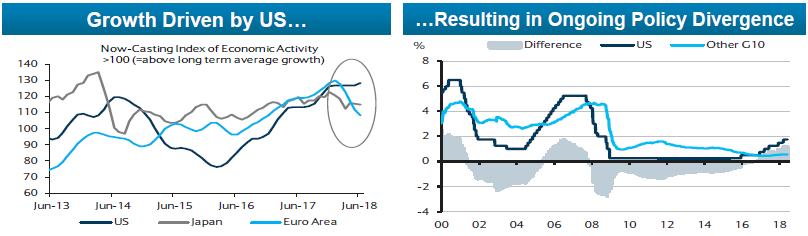
 The Federal Reserve held two meetings during Q2 2018. The Federal Funds Target Rate was raised at the June 13
 While the Fed continues a less accommodative posture, other Central Banks aren’t necessarily following suit. The Bank of Japan is still buying an annualized JPY45 trillion of Japanese Government Bonds (“JGB’s”) and targeting a JGB yield of 0%.