CAM High Yield Market Note
9/7/2018
Fund Flows & Issuance: According to a Wells Fargo report, flows week to date were -$0.7 billion and year to date flows stand at -$34.7 billion. New issuance for the week was $2.2 billion and year to date HY is at $133.4 billion, which is -23% over the same period last year.
(Bloomberg) High Yield Market Highlights
- Junk bonds remained impervious to drifting stocks, rising VIX and falling oil prices as the supply-starved primary priced three drive-by bond offerings yesterday, suggesting healthy appetite for risk.
- Junk investors shrugged off outflows from retail funds
- Lipper reported outflows for week ended September 5, the first negative in five weeks
- Dollar books on Thomson Reuters, rated CCC, are already oversubscribed 4-5 times, amid expectation that it will price tighter than initial price talk
- Investors ignored high leverage, focused on cash flow, subscriber base
- Earlier in the week, Intelsat, rated triple-C, got orders of more than $4b for a $2b offering
- Supply is expected to pick up momentum
- September is typically busiest or second busiest month
- Supporting high yield are earnings, low default rate
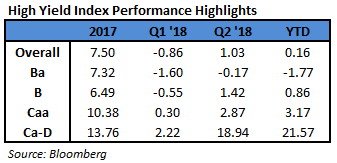
- CCCs beat BBs and single-Bs with YTD return of 4.60%
- Investment-grade bonds were down 2.1% YTD
- (PR Newswire) U.S. Concrete Strengthens Aggregates Operations with Strategic Acquisition in Texas
- US Concrete a leading national supplier of ready-mixed concrete and aggregates, today announced that it has expanded its aggregates business in Texas with the acquisition of Leon River Aggregate Materials, LLC (“Leon River”), a sand and gravel producer based in Proctor, Texas. The acquisition adds over 400 acres of land with reserves to the Company’s operations and a state-of-the-art processing plant to achieve the highest efficiencies.
- Furthermore, U.S. Concrete also announced that it has completed the divestiture of its Dallas/Fort Worth area lime operations to Lhoist North America, which includes two fixed plants, lime tankers and raw material tankers.
- “We are excited to strengthen our aggregates operations in West Texas and to use the processing facility to produce high-quality materials that will be used in many of the market’s ongoing and planned construction projects,” said William J. Sandbrook, Chairman, President and CEO of U.S. Concrete. “The lime divestiture gives us the ability to further our strategic focus of optimizing our portfolio of assets and allocating money directly to growing our aggregates business while concurrently improving our balance sheet by reducing debt.”
- (Digitimes) Samsung, SK Hynix reportedly to defer expansion plans
- Samsung Electronics and SK Hynix both intend to defer their capacity expansion plans, as a slowdown in customer demand will be dragging down DRAM and NAND flash memory prices through the first half of 2019, according to industry sources.
- The global NAND flash market has remained in oversupply in the third quarter of 2018 despite the period being the traditional peak season, the sources said. Suppliers’ continued ramp-ups of 64- and 72-layer 3D NAND flash output coupled with the limited demand growth due to the saturated notebook and smartphone markets are being identified as the factors bringing down the memory prices.
- Meanwhile, the industry supply chain is flooded with substandard NAND flash chips, which have made a further negative impact on the memory prices, the sources noted. NAND flash contract prices are likely to fall by a larger-than-expected 10-15% sequentially in the third quarter and another 15% in the fourth, the sources said.
- Industry leader Samsung, which used to supply 3D NAND chips for its own SSDs and other products, has started shipping the memory externally in the third quarter of 2018, according to the sources. Samsung is also slowing down the pace of expanding its 3D NAND chip output, with new production capacity unlikely to go online until the first half of 2019, the sources said.
- Samsung has also put on hold its plans to build additional new production capacity for DRAM chips at its fabs in Hwaseong and Pyeongtaek, the sources continued. The chip vendor previously planned to build an additional 30,000 wafers monthly for DRAM memory starting the third quarter of 2018, the sources said.
(Barron’s) Western Digital, Seagate Slump on Gloomy Evercore Forecast
- Shares of Western Digital (WDC) and Seagate Technology (STX) were battered Tuesday after a report from Evercore ISI warned of declining profit margins for both makers of hard drives and flash memory storage devices.
- Seagate’s stock was down 8.6% to $48.92; Western Digital dropped 6.2% to $59.33.
- Evercore downgraded its rating to “underperform” for Seagate while lowering its price target to $45 from $55. It wasn’t much better for Western Digital, whose stock was lowered to “in line.” The price target was sliced to $75 from $100.
- “With topline likely flattish at best, GMs [gross profit margins] heading lower, and worse than expected NAND [flash memory] pricing driving increased potential for cannibalization of HDDs [hard disk drives], we see risk to the downside for Seagate after an excellent run,” Evercore analyst C.J. Muse warned in a note to clients Tuesday. “With NAND pricing expected to decline more aggressively through 1H19 … we simply find it hard to see [Western Digital] shares working into year-end.”
- Muse expects average selling prices for NAND flash memory to dip by a “low double digit” percentage in the first half of 2019, as they did from late 2014 through early 2015.
- (Bloomberg) Seagate Downgraded to Underperform at Evercore ISI
- Evercore ISI analyst C.J. Muse downgraded the recommendation on Seagate Technology to underperform from in-line.
- PT lowered to $45 from $55, implies 16% decrease from last close.
- Analysts raised their consensus one-year target price for the stock by 6.1 percent in the past three months.
- Investors who followed Muse’s recommendation received a 0 percent return in the past year, compared with a 79 percent return on the shares.

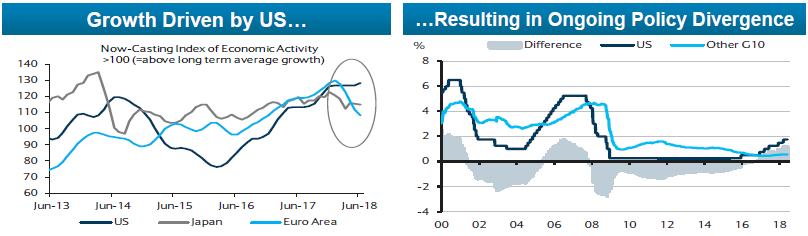
 The Federal Reserve held two meetings during Q2 2018. The Federal Funds Target Rate was raised at the June 13
 While the Fed continues a less accommodative posture, other Central Banks aren’t necessarily following suit. The Bank of Japan is still buying an annualized JPY45 trillion of Japanese Government Bonds (“JGB’s”) and targeting a JGB yield of 0%.