Category: Insight

07 Oct 2022

CAM High Yield Weekly Insights

Fund Flows & Issuance:  According to a Wells Fargo report, flows week to date were $0.8 billion and year to date flows stand at -$60.7 billion.  New issuance for the week was nil and year to date issuance is at $88.3 billion.


(Bloomberg)  High Yield Market Highlights

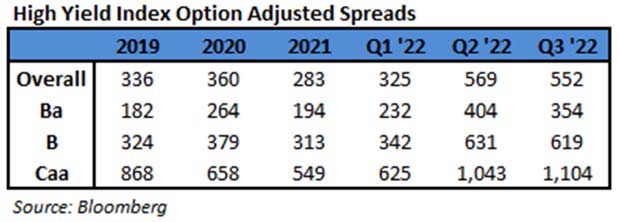
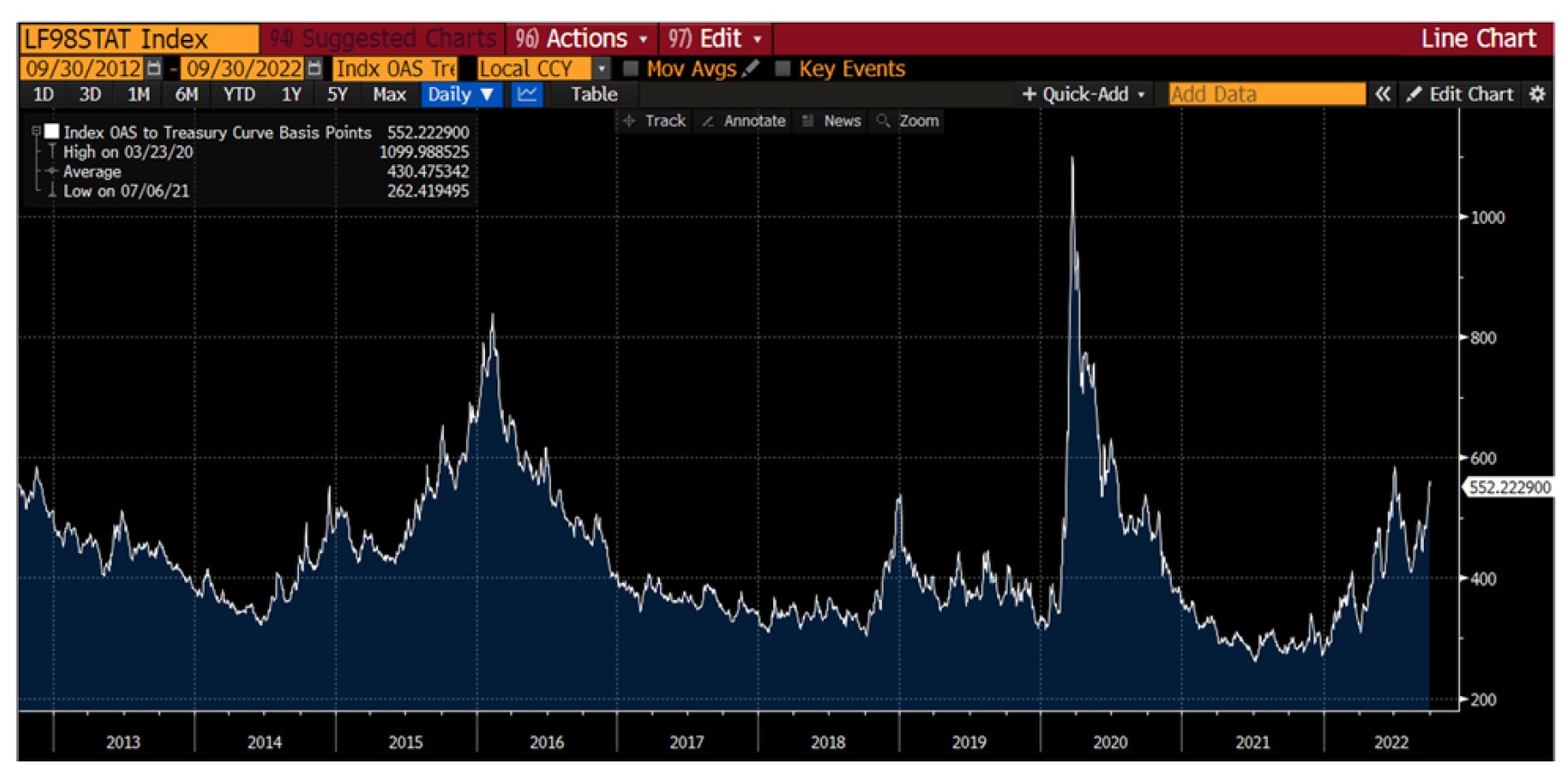
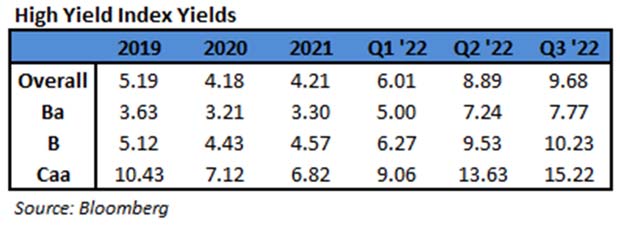
  • U.S. junk bonds were headed for a weekly gain heading into the jobs report on Friday morning, as yields moved to 9.13% from 9.88%, the highest since April 2020.
  • The gains came amid weak US manufacturing data and a 14-month low in US job openings.
  • The junk-bond rally followed a broad risk-on move as equities rebounded from the worst monthly loss in more than two years in September.
  • Still, the gains may be short-lived as Fed officials warn that market expectations for a pivot are misplaced and that there’s a need to boost rates to “restrictive territory.”
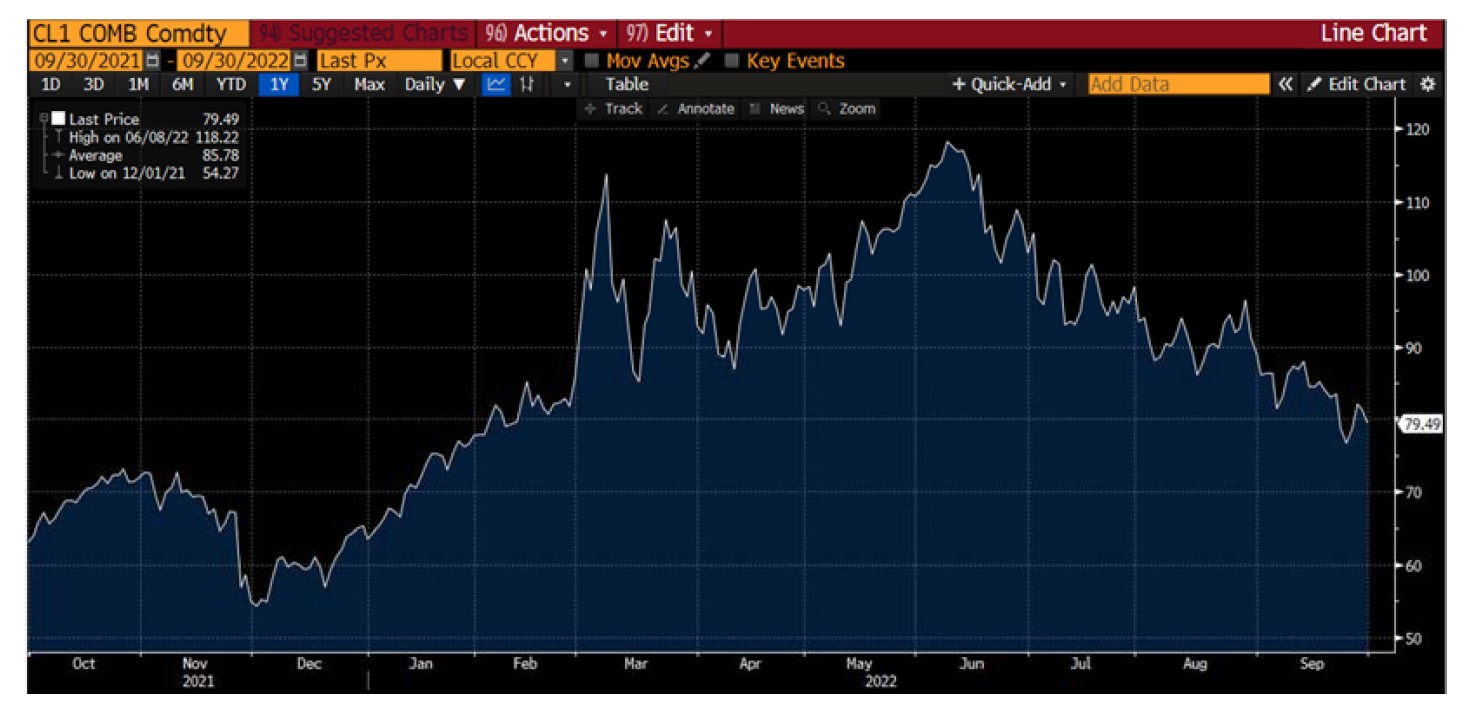
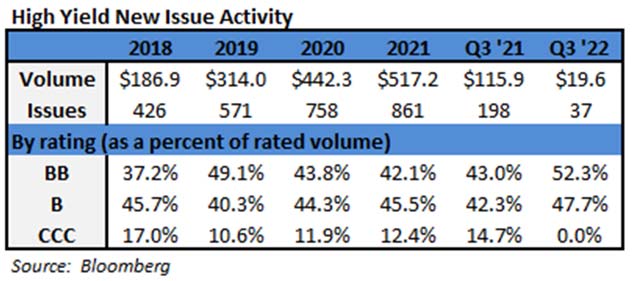
  • Continuing macro uncertainty, rising oil prices and steadily rising yields have turned issuers away from the primary market.
  • The sudden rally in junk bonds after the September losses brought investors back to the asset class with a cash inflow of just under $1b this week.


(Bloomberg)  US Jobs Rise While Unemployment Drops, Keeping Pressure on Fed

  • U.S. employers continued to hire at a solid pace last month and the jobless rate unexpectedly returned to a historic low, indicating a sturdy labor market that puts the inflation-focused Federal Reserve on course for another outsize interest-rate hike.
  • Nonfarm payrolls increased 263,000 in September after a 315,000 gain in August, a Labor Department report showed Friday. The unemployment rate unexpectedly dropped to 3.5%, matching a five-decade low. Average hourly earnings rose firmly.
  • The median estimates in a Bloomberg survey of economists called for a 255,000 advance in payrolls and for the unemployment rate to hold at 3.7%. Hiring was relatively broad based, led by gains in leisure and hospitality and health care.
  • The figures are the latest illustration of the perennial strength of the US job market. While there have been some indications of moderating labor demand — most notably a recent decline in job openings and an uptick in layoffs in some sectors — employers, many still short-staffed, continue to hire at a solid pace. That strength is not only underpinning consumer spending but also fueling wage growth as businesses compete for a limited pool of workers.
  • The Fed, meanwhile, is hoping to see a significant softening in labor market conditions, with the goal of cooling wage growth and ultimately inflation. While the payrolls advance was the smallest since April 2021, policy makers are watching to see if their rate hikes spur an increase in the unemployment rate.
  • This is the last jobs report Fed officials will have in hand before their November policy meeting as they consider a fourth-straight 75-basis point interest-rate hike. Fresh inflation data out next week will also play a fundamental role in their decision making. The report is projected to show the depth and breadth of the Fed’s inflation problem, with a key gauge of consumer prices potentially worsening.
  • The labor force participation rate — the share of the population that is working or looking for work — eased to 62.3%. Among those ages 25 to 54, it also dipped.
  • The jobs report showed average hourly earnings were up 0.3% from August and up 5% from a year earlier, a slight deceleration from the prior month but still historically elevated. The solid increase suggests the Fed will have to continue to raise interest rates as it aims to rein in rapid wage growth that has bolstered household spending.
  • Central bank officials have been clear recently about their commitment to taming inflation, even if that leads to higher unemployment and recession, because they say that failing to do so would be worse for Americans. Fed Chair Jerome Powell said last month that slower growth and a softer labor market are painful for the public, but that there isn’t a “painless” way to get inflation down.


This information is intended solely to report on investment strategies identified by Cincinnati Asset Management. Opinions and estimates offered constitute our judgment and are subject to change without notice, as are statements of financial market trends, which are based on current market conditions. This material is not intended as an offer or solicitation to buy, hold or sell any financial instrument. Fixed income securities may be sensitive to prevailing interest rates. When rates rise the value generally declines. Past performance is not a guarantee of future results.
16 Sep 2022

CAM High Yield Weekly Insights

Fund Flows & Issuance:  According to a Wells Fargo report, flows week to date were $0.1 billion and year to date flows stand at -$54.8 billion.  New issuance for the week was $3.0 billion and year to date issuance is at $82.3 billion.


(Bloomberg)  High Yield Market Highlights

  • U.S. junk bonds are headed for a weekly loss to end the August rebound after a higher-than-expected inflation reading on Tuesday triggered a broad market selloff.  Yields surged to a two-month high of 8.61% after steadily rising for three straight sessions, pushing the week-to-date loss to 1.5%.
  • The losses extended across ratings in the U.S. high yield market, with CCCs leading the pack with the worst week-to- date loss of 1.7%, after sliding for three consecutive sessions. Yields rose to a two-week high of 13.72% and spreads were approaching distressed levels.
  • The primary market was suddenly jolted after the CPI data earlier in the week fueled concerns that the Federal Reserve may need to raise benchmark interest rate by even 100bps to tame inflation and trigger a recession.
  • The primary market may pause after the Citrix debt sale was used to assess the risk appetite and clearing price levels for new debt amid rising rates and slowing economy. Nielsen Holdings and Tenneco are among the other leveraged buyouts in the queue to sell debt at some point.


(Bloomberg)  Inflation Surprise Puts Onus on Fed to Hit Brakes Even Harder

  • The U.S. economy has shown surprising resilience in the face of the fastest inflation and interest-rate hikes in a generation. That means the Federal Reserve will have to stomp even harder on demand.
  • What started as a pandemic-driven supply shock has morphed into widespread inflation rooted just as much in resilient demand, underscored by unexpectedly high numbers that dashed hopes price gains were ebbing. While consumers are showing some signs of slowing, they’re still largely keeping up with persistent price pressures, powered by historic wage gains.
  • All told, the Fed has a much harder task on its hands than previously thought. If Americans won’t dial back spending further, odds favor the central bank becoming that much more aggressive to take more wind out of the economy’s sails with the goal of bringing inflation down.
  • “It tells you that it’s going to take a longer time, and will require higher rates — and in macro language, maybe even require more demand destruction,” as in higher unemployment and slower growth, said Torsten Slok, chief economist at Apollo Management. “It raises the probability of a recession.”
  • Consumer prices advanced by more than forecast in August, defying expectations for a monthly drop due to falling gasoline prices. Shelter, food and medical care were among the largest contributors to price growth, underscoring the breadth and severity of inflation with several categories posting record increases.
  • “My experience with inflation is that some of the components that were very strong in today’s report, they tend to be sticky and have a lot of inertia,” like rent, said Blerina Uruci, U.S. economist at T. Rowe Price Associates. “So I would expect those to remain pretty strong in the coming months.”
  • The Atlanta Fed’s so-called sticky CPI measure rose 6.1% in August from a year ago, the biggest gain in 40 years. Meantime, the Cleveland Fed’s median CPI, which excludes categories with the largest price changes, increased by the most in data back to 1983.
  • Excluding the volatile food and energy categories, the so-called core CPI climbed 0.6% from July, double the median estimate in a Bloomberg survey of economists. The core measure rose 6.3% from a year ago, the first acceleration in six months and near a four-decade high, the Labor Department’s report showed.
  • “The composition is even more troubling than the aggregate reading,” Stephen Stanley, chief economist at Amherst Pierpont Securities, said in a note. “Outside of falling gasoline prices, inflation appears to be just as hot as ever, which means that the Fed still has plenty of work to do.”
  • It also means that the Biden administration and fellow Democrats have plenty of work to do, as the latest data may threaten what had been growing optimism in the party that they would hold their congressional majorities in November.
  • Traders are now fully expecting the central bank to raise interest rates by another 75 basis points when policy makers meet next week, which would be the third-straight hike of that size. They’re also upping bets that officials will go bigger at their November gathering and see the tightening cycle peaking around 4.3% early next year — more than a quarter-point higher than what was projected before the CPI report.
  • Chair Jerome Powell has communicated a stronger resolve to stamp out inflation since the Fed’s summit in Jackson Hole last month, signaling that the central bank is likely to keep raising interest rates and leave them elevated for a while. He’s stuck to that hawkish view and several of his colleagues also support hiking rates to a point that more clearly restricts demand.


This information is intended solely to report on investment strategies identified by Cincinnati Asset Management. Opinions and estimates offered constitute our judgment and are subject to change without notice, as are statements of financial market trends, which are based on current market conditions. This material is not intended as an offer or solicitation to buy, hold or sell any financial instrument. Fixed income securities may be sensitive to prevailing interest rates. When rates rise the value generally declines. Past performance is not a guarantee of future results.
16 Sep 2022

CAM Investment Grade Weekly Insights

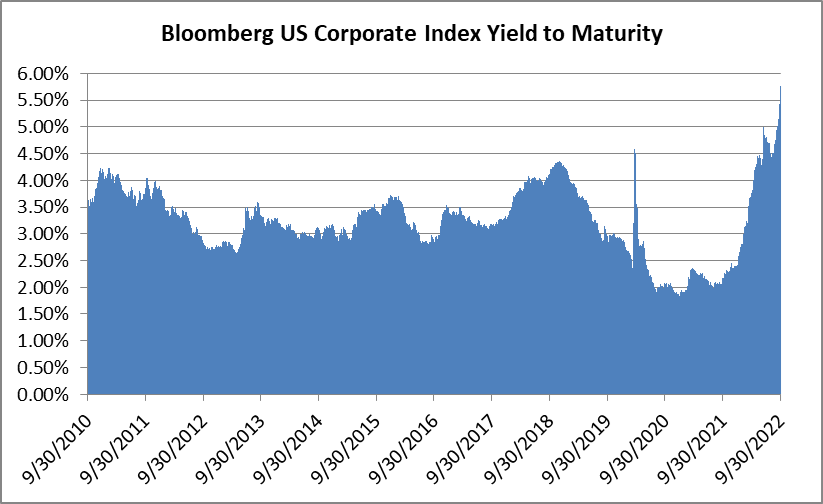
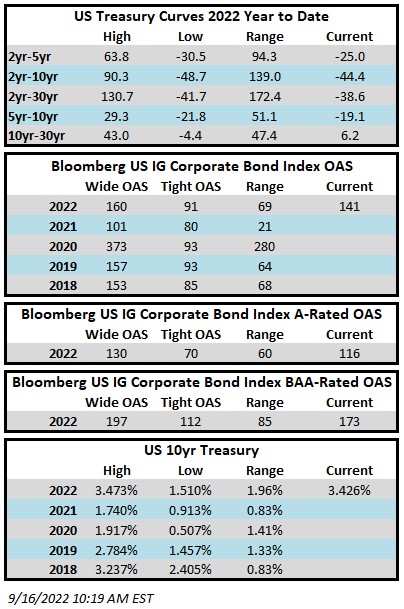
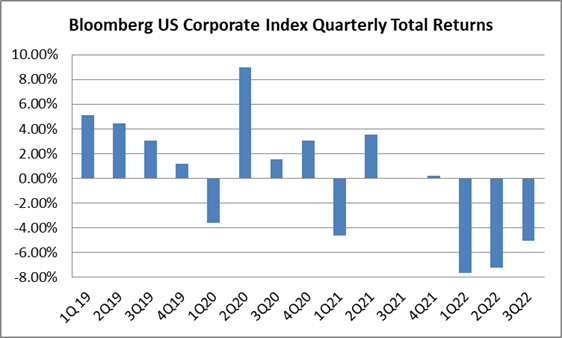
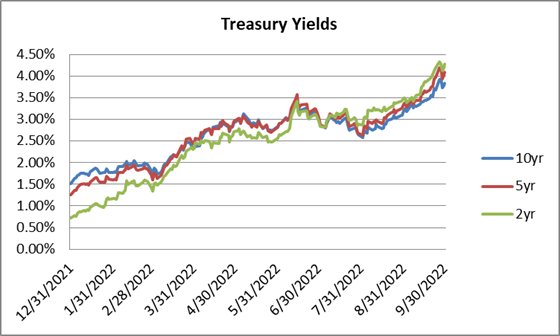
Investment grade credit spreads were unchanged for most of the week but the market has been drifting wider Friday morning so the index may finish 1-2 basis points wider by the time the sun has set on the week.  IG credit led the way this week having substantially outperformed other risk assets on a spread basis.   The Bloomberg US Corporate Bond Index closed at 141 on Thursday September 15 after having closed the week prior at 141. The 10yr Treasury closed last week at 3.31% and is trading at 3.43% as we go to print on Friday morning.  Through Thursday the Corporate Index had a negative YTD total return of -15.58% while the YTD S&P500 Index return was -17.2% and the Nasdaq Composite Index return was -26.98%.

The big economic news of the week was the CPI print on Tuesday morning which showed that prices increased slightly in August versus market expectations for a slight decrease.  This was a disappointing number for risk assets and stocks immediately reacted by trading much lower and Treasuries of all maturities sold off sharply.  This report showed that the Fed still has much work to do before inflation cools to a level nearer its 2% target. CPI data has assured a 75bp hike at the FOMC meeting next week and has even brought forth the possibility of a surprise 100bp hike.  Thursday morning brought with it the second big economic data point of the week with mixed retail sales numbers that showed a stronger than expected increase for August but a revision downward for July.  The broad picture painted by the last couple retails sales reports has showed that consumer spending has been slowing for durable goods but has remained relatively strong for services.  The Fed will be on the tape next week with its rate decision on Wednesday.

This was a volatile week with equities trading lower and Treasuries selling off, both of which served to impugn supply estimates with $18.7bln of new debt priced relative to estimates of $35-40bln.  Next week the street is looking for about $15bln of issuance with Wednesday off limits for issuers due to the FOMC.  Once again we find ourselves in more of a day-to-day type of environment for the new issue calendar.

Fund flows held up remarkably well this week considering the soft sentiment for risk assets.  Per data compiled by Wells Fargo, outflows for the week of September 8–14 were -$0.4bln which brings the year-to-date total to -$111.6bln.  This was the third consecutive week of modest outflows and the pace of outflows has decelerated each of the past three weeks.

This information is intended solely to report on investment strategies identified by Cincinnati Asset Management. Opinions and estimates offered constitute our judgment and are subject to change without notice, as are statements of financial market trends, which are based on current market conditions. This material is not intended as an offer or solicitation to buy, hold or sell any financial instrument. Fixed income securities may be sensitive to prevailing interest rates. When rates rise the value generally declines. Past performance is not a guarantee of future results. 
09 Sep 2022

CAM Investment Grade Weekly Insights

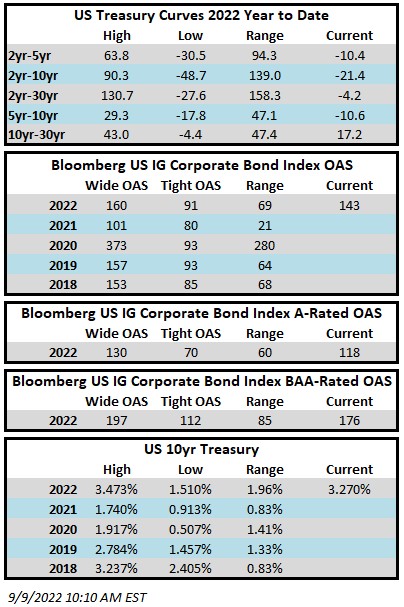
Investment grade credit spreads were pushed wider to start the week after a deluge of new issue supply on Tuesday.  By mid-Wednesday morning spreads were trending tighter after investors had a chance to digest issuance and now this Friday morning it is clear that the market is set to finish the week better than last which sets up well for another bout of new issue on Monday. The Bloomberg US Corporate Bond Index closed at 143 on Thursday September 8 after having closed the week prior at 145. The 10yr Treasury closed last week at 3.19% and is trading at 3.27% as we go to print on Friday morning.  Through Thursday the Corporate Index had a negative YTD total return of -15.02% while the YTD S&P500 Index return was -15.12% and the Nasdaq Composite Index return was -23.74%.

The FOMC does not meet until September 21 but next Tuesday will see the release of the latest CPI figure which is a big data point that will guide the Fed in its choice of a 50bp or 75bp hike 12 days from now.  Other central banks joined the rate-hike party this week.  On Wednesday, the Bank of Canada increased its target for the overnight rate by 75bps to 3.25%, a 14-year high for that country.  The European Central Bank followed suit on Thursday by increasing its deposit rate from 0% to 0.75%.  The ECB also slashed its forecast of economic growth in 2023 to a mere 0.9%.  Critics believe this growth target is overly optimistic and that the European economy will find itself in recession sooner rather than later and we at CAM agree with that view.

The holiday shortened week saw 31 companies sell over $51bln of new debt.  The street is looking for $35-40bln of issuance next week and with CPI at 8:30am on Tuesday we would expect a tidal wave of issuance on Monday if the market tone is receptive as companies look to get ahead of that economic print.  Issuance right now is very much day-to-day depending on the market’s appetite for risk on any given day as well as being highly dependent on the increasingly volatile Treasury market.

Per data compiled by Wells Fargo, outflows moderated this week of September 1–7 to -$0.9bln which brings the year-to-date total to -$111.2bln.  This was the second consecutive week of modest outflows on the back of a 5 week streak of inflows for the asset class.

This information is intended solely to report on investment strategies identified by Cincinnati Asset Management. Opinions and estimates offered constitute our judgment and are subject to change without notice, as are statements of financial market trends, which are based on current market conditions. This material is not intended as an offer or solicitation to buy, hold or sell any financial instrument. Fixed income securities may be sensitive to prevailing interest rates. When rates rise the value generally declines. Past performance is not a guarantee of future results. 
26 Aug 2022

CAM Investment Grade Weekly Insights

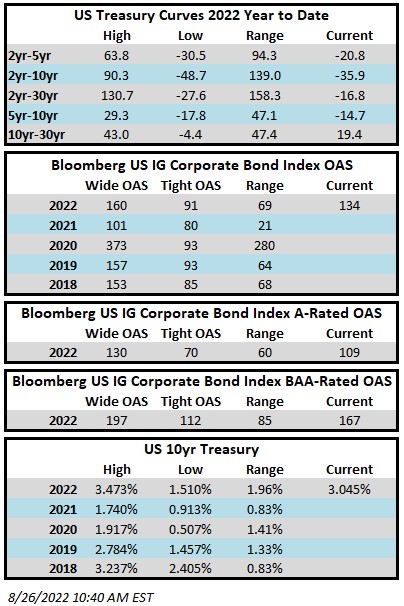
Investment grade credit spreads drifted wider in the first half of the week and then traded tighter amid low volume into Friday morning.  After Fed Chair Jerome Powell spoke on Friday the street tried to take spreads wider but trading volume has remained low with the market in its end-of-summer seasonal slow-down.  The Bloomberg US Corporate Bond Index closed at 134 on Thursday August 25 after having closed the week prior at 136. After the dust settles the index is likely to finish the week unchanged or close to it.  The 10yr Treasury closed last week at 2.97% and is trading at 3.05% as we go to print on Friday morning.  Through Thursday the Corporate Index had a negative YTD total return of -13.1% while the YTD S&P500 Index return was -11% and the Nasdaq Composite Index return was -18.78%.

Economic data this week was light relative to the last two weeks and much of the week was spent with investors anticipating Powell’s Friday morning speech.  The speech was less than 10 minutes in length, but that was all the market needed to understand that the Fed is committed to using restrictive policy to reduce inflation even if it causes some pain for households and businesses.  Chair Powell said 75bps is still on the table for the Fed’s September 21 FOMC rate decision.

There was no new issuance this week.  It wouldn’t have been surprising if there would have been a deal or two on Monday or Tuesday but Monday was a volatile day for stocks and risk assets in general so issuers decided to pack it in for the week, and probably for the summer.  We anticipate no issuance again next week before things start to pick up again after Labor Day.  September is expected to see a high volume of issuance.

Investment grade credit reported a fifth straight week of inflows.  Per data compiled by Wells Fargo, inflows for the week of August 18–24 were +$2.8bln which brings the year-to-date total to -$108.9bln.

This information is intended solely to report on investment strategies identified by Cincinnati Asset Management. Opinions and estimates offered constitute our judgment and are subject to change without notice, as are statements of financial market trends, which are based on current market conditions. This material is not intended as an offer or solicitation to buy, hold or sell any financial instrument. Fixed income securities may be sensitive to prevailing interest rates. When rates rise the value generally declines. Past performance is not a guarantee of future results. 
26 Aug 2022

CAM High Yield Weekly Insights

Fund Flows & Issuance:  According to a Wells Fargo report, flows week to date were -$4.1 billion and year to date flows stand at -$48.3 billion.  New issuance for the week was $0.4 billion and year to date issuance is at $79.3 billion.


(Bloomberg)  High Yield Market Highlights

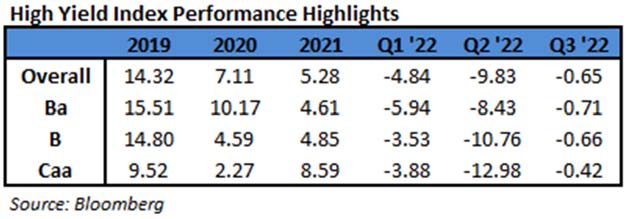
  • U.S. junk bonds head toward a loss for the second consecutive week as investors pull $4.1 billion from US junk bonds for the second-biggest such withdrawal of the year on renewed concerns about recession.
  • Yields surged and spreads widened across ratings for the second consecutive week, ending a rally that began in July and extended to the first two weeks of August.
  • Junk bond yields rose 20bps this week to near 8%. Spreads widened 14bps to +446.
  • BBs, the most rate-sensitive in the junk bond market, are moving toward a big loss in August, with month-to-date losses at 1.15% for the worst performing asset in the US high-yield market.
  • BBs are on track to end with losses for the second straight week.
  • CCC spreads have steadily climbed back to distressed levels widening 52bps week-to-date to +975. The index is also expected to end the week in red, with week-to-date losses at 0.78%.


(Bloomberg)  Powell Says History Warns Against Prematurely Loosening Policy

  • Federal Reserve Chair Jerome Powell signaled the US central bank is likely to keep raising interest rates and leave them elevated for a while to stamp out inflation, and he pushed back against any idea that the Fed would soon reverse course.
  • “Restoring price stability will likely require maintaining a restrictive policy stance for some time,” Powell said Friday in remarks prepared for the Kansas City Fed’s annual policy forum in Jackson Hole, Wyoming. “The historical record cautions strongly against prematurely loosening policy.”
  • He said restoring inflation to the 2% target is the central bank’s “overarching focus right now” even though consumers and businesses will feel economic pain. He reiterated that another “unusually large” increase in the benchmark lending rate could be appropriate when officials gather next month, though he stopped short of committing to one.
  • “Our decision at the September meeting will depend on the totality of the incoming data and the evolving outlook,” he said.
  • “Restoring price stability will take some time and requires using our tools forcefully to bring demand and supply into better balance,” Powell said.
  • Other Fed speakers in recent days have also pushed back against expectations, priced into futures markets, that the Fed would raise rapidly to a restrictive policy stance and then begin to ease.
  • Restoring price stability will require a “sustained” period of below-trend growth and a weaker labor market, Powell said. “While higher interest rates, slower growth, and softer labor market conditions will bring down inflation, they will also bring some pain to households and businesses,” he said.
  • Inflation according to the Fed’s preferred measure rose 6.3% for the 12-month period ending July, according to a government report released earlier on Friday , while the core measure minus food and energy rose 4.6%.
  • “While the lower inflation readings for July are welcome, a single month’s improvement falls far short of what the committee will need to see before we are confident that inflation is moving down,” the Fed chief told the audience.
  • “We are moving our policy stance purposefully to a level that will be sufficiently restrictive to return inflation to 2%.”
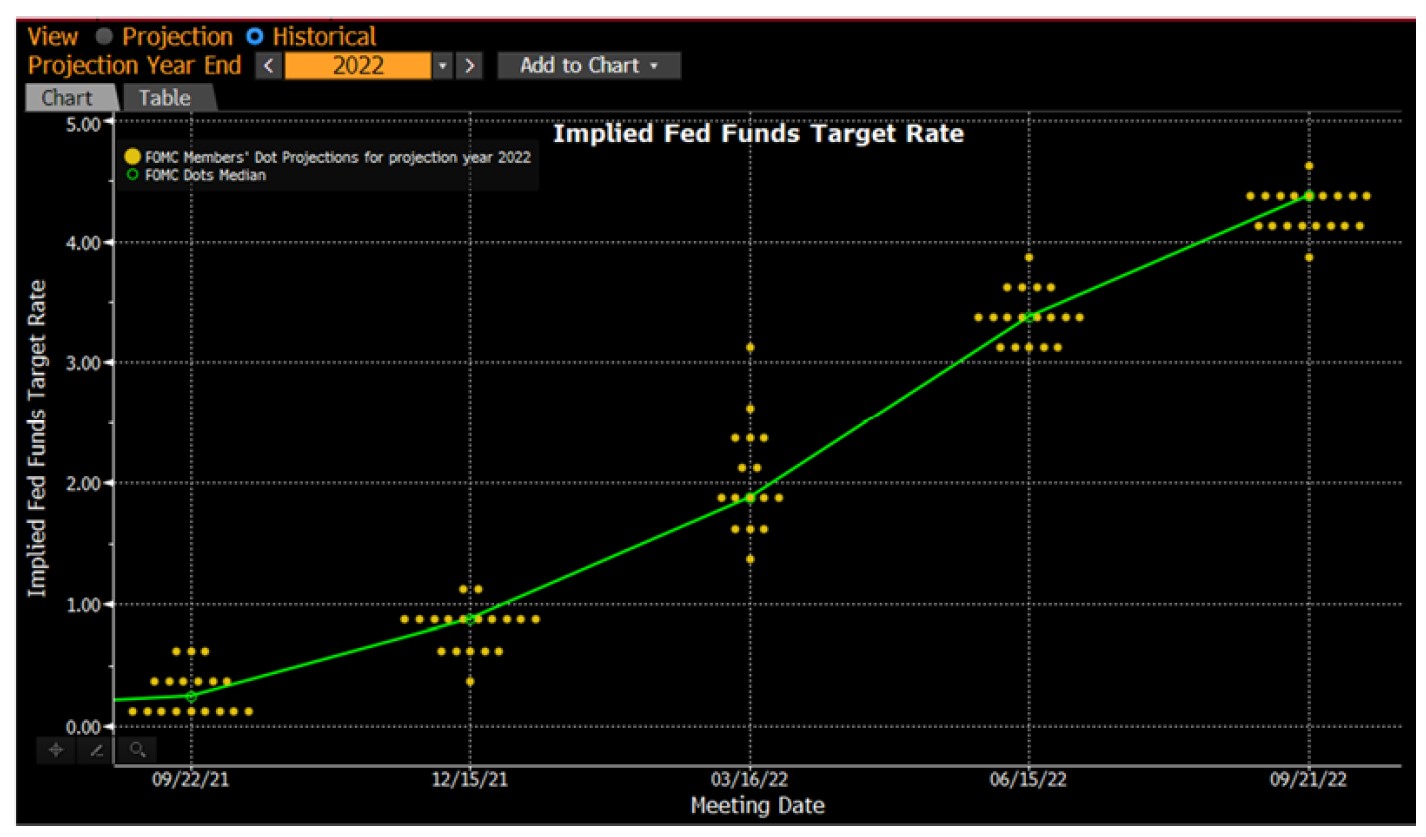
  • Fed officials in June projected rates rising to 3.4% by the end of this year, according to their median estimate, and 3.8% by end 2023. They will update those forecasts in September.


This information is intended solely to report on investment strategies identified by Cincinnati Asset Management. Opinions and estimates offered constitute our judgment and are subject to change without notice, as are statements of financial market trends, which are based on current market conditions. This material is not intended as an offer or solicitation to buy, hold or sell any financial instrument. Fixed income securities may be sensitive to prevailing interest rates. When rates rise the value generally declines. Past performance is not a guarantee of future results.
19 Aug 2022

CAM High Yield Weekly Insights

Fund Flows & Issuance:  According to a Wells Fargo report, flows week to date were $0.1 billion and year to date flows stand at -$44.1 billion.  New issuance for the week was $4.7 billion and year to date issuance is at $78.9 billion.


(Bloomberg)  High Yield Market Highlights

  • U.S. junk bonds are on track to end the six-week gaining streak after steadily falling for three consecutive sessions, with a week-to-date loss of 0.67%. Yields jump 16bps week-to-date to 7.59%, rising for the first time in seven weeks and the biggest weekly leap since early July after Federal Reserve minutes noted risks from the central bank tightening more than necessary. The losses stretched across the high yield market, with CCCs headed toward its first weekly loss, falling by a modest 0.29% and snapping the four-week rally. The losses followed a three-day decline, the longest losing streak in five weeks.
  • CCC yields are headed toward the biggest weekly surge since July 1, rising 28bps week-to-date to 12.51%.
  • Junk bond losses accelerated after mixed signals from different FOMC voting members, causing uncertainty over the extent of rate hikes in the coming months and its impact on growth.
  • The primary market saw some borrowers rush in a hurry to take advantage of the risk-on move ahead of Jackson Hole symposium next week where the Fed could reiterate that it was focused on taming inflation and the fight against inflation continues.
  • The issuance volume this week totals almost $5b, the busiest since early June.
  • The month-to-date supply tally was at a modest $8b, the slowest August since 2014.
  • The junk bond market may extend the decline on Friday amid a broader risk-off move. U.S. equity futures sank with Treasuries after a chorus of Federal Reserve officials reiterated their resolve to continue rate hikes and traders raised tightening wagers for other major central banks.


(Bloomberg)  Fed Officials Offer Mixed Signals on Size of September Rate Hike

  • U.S. central bankers offered divergent signals over the size of the next interest-rate hike, with St. Louis’s James Bullard urging another 75 basis-point move while Kansas City’s Esther George struck a more cautious tone.
  • Bullard, who is one of the most hawkish policy makers at the U.S. central bank, told the Wall Street Journal in an interview published Thursday that he favored going big again, arguing “we should continue to move expeditiously to a level of the policy rate that will put significant downward pressure on inflation.”
  • “I don’t really see why you want to drag out interest rate increases into next year,” he said.
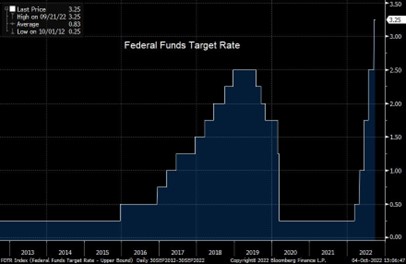
  • The Fed in July raised the target range for its benchmark rate by three-quarters of a percentage point to 2.25% to 2.5%, following a similar-sized hike in June to cool the hottest inflation in 40 years. Officials have since signaled that either 50, or another 75 basis points, were on the table for their Sept. 20-21 meeting, depending on the data. They get fresh monthly readings on inflation and employment between now and then.
  • Both Bullard and George are voters this year on the rate-setting Federal Open Market Committee. But George, who hosts the Fed’s annual policy retreat next week in Jackson Hole, Wyoming, has sounded more dovish than Bullard in recent months, after many years of being viewed as a hawk.
  • She backed the July hike but dissented in June in favor of a smaller half-point increase, citing concern the larger move could stoke policy uncertainty. Her remarks Thursday continued to tilt dovish.
  • “I think the case for continuing to raise rates remains strong. The question of how fast that has to happen is something my colleagues and I will continue to debate, but I think the direction is pretty clear,” she said in Independence, Missouri.
  • “We have done a lot, and I think we have to be very mindful that our policy decisions often operate on a lag. We have to watch carefully how that’s coming through.”
  • George also noted that the Fed was shrinking its $8.9 trillion balance sheet while raising rates, which would also help to restrain the economy. The pace of decline steps up next month to an annual pace of around $1 trillion.
  • Fed officials who have spoken since the July meeting have pushed back against any perception that they’d be pivoting away from tightening any time soon. They’ve made it clear that curbing the hottest inflation in four decades is their top priority.


This information is intended solely to report on investment strategies identified by Cincinnati Asset Management. Opinions and estimates offered constitute our judgment and are subject to change without notice, as are statements of financial market trends, which are based on current market conditions. This material is not intended as an offer or solicitation to buy, hold or sell any financial instrument. Fixed income securities may be sensitive to prevailing interest rates. When rates rise the value generally declines. Past performance is not a guarantee of future results.
19 Aug 2022

CAM Investment Grade Weekly Insights

Investment grade credit spreads were generally tighter to start the week and then drifted wider in the second half.  The Bloomberg US Corporate Bond Index closed at 134 on Thursday August 18 after having closed the week prior at 132.  The 10yr Treasury closed last week at 2.83% and is trading at 2.95% as we go to print on Friday morning.  Economic data painted differing pictures this week.  The Empire Manufacturing survey on Monday was absolutely dreadful and caused investors to ponder the impact of slowing growth in an economically important region.  Housing starts declined for the sixth consecutive month and mortgage applications came in lighter than estimates.  On the bright side, July retail sales showed some encouraging signs.  Fed speakers throughout the week did their best to remind investors that they will do whatever it takes to lower inflation to 2%.  This is not an opinion piece, but since you asked, it is our view that the market is much too complacent about the Fed and there seems to be this prevailing belief that the Fed will be ready and willing to immediately slash the Funds Rate in 2023 at the first hint of economic weakness.  We simply disagree with this view and believe that the Fed is willing to inflict pain on equities and riskier assets in its quest to quell inflation. Through Thursday the Corporate Index had a negative YTD total return of -12.23% while the YTD S&P500 Index return was -9.22% and the Nasdaq Composite Index return was -16.69%.

Primary issuance was in line with expectations this week as more than $22bln of new debt was brought to market.  As pointed out by Bloomberg, this was the fifth week in a row where actual volume met or exceeded concensus expectations, a good sign for the health of the primary market.  Issuance will likely slow significantly until after Labor day at which point we expect substantial issuance if investors remain receptive.  There has been $912bln of new issuance YTD which trails 2021’s pace by 5% according to data compiled by Bloomberg.

Investment grade credit reported a fourth straight week of inflows.  Per data compiled by Wells Fargo, inflows for the week of August 11–17 were +$3.9bln which brings the year-to-date total to -$111.7bln.

This information is intended solely to report on investment strategies identified by Cincinnati Asset Management. Opinions and estimates offered constitute our judgment and are subject to change without notice, as are statements of financial market trends, which are based on current market conditions. This material is not intended as an offer or solicitation to buy, hold or sell any financial instrument. Fixed income securities may be sensitive to prevailing interest rates. When rates rise the value generally declines. Past performance is not a guarantee of future results. 
12 Aug 2022

CAM Investment Grade Weekly Insights

Investment grade credit performed strongly this week as spreads moved tighter throughout.  The Bloomberg US Corporate Bond Index closed at 135 on Thursday August 11 after having closed the week prior at 141.  The 10yr Treasury closed last week at 2.83% and is trading at 2.85% as we go to print on Friday afternoon.  On the economic front, the big news of the week was Wednesday’s CPI print which was the first data point that showed inflation might be slowing.  Both headline and core inflation came in below expectations and stocks rallied on the news but most market participants agree that the battle is far from over; but it is an encouraging sign nonetheless.  Through Thursday the Corporate Index had a negative YTD total return of -12.4% while the YTD S&P500 Index return was -10.89% and the Nasdaq Composite Index return was -17.31%.

Primary issuance continued to impress this week, although at a more subdued pace than the previous two weeks.  Just over $30bln of new debt was brought to market.  The primary market typically experiences a seasonal slowdown in the second half of August before things pick back up after Labor day.  There has been $890bln of new issuance YTD which trails 2021’s pace by 6% according to data compiled by Bloomberg.

Investment grade credit reported a second straight week of strong inflows.  Per data compiled by Wells Fargo, inflows for the week of August 4–10 were +$4.7bln which brings the year-to-date total to -$115.3bln.

12 Aug 2022

CAM High Yield Weekly Insights

Fund Flows & Issuance:  According to a Wells Fargo report, flows week to date were $0.9 billion and year to date flows stand at -$44.8 billion.  New issuance for the week was $3.5 billion and year to date issuance is at $74.7 billion.


(Bloomberg)  High Yield Market Highlights

  • U.S. junk bonds are headed toward the sixth straight week of gains after steadily climbing in three of the last four sessions as yields plunge to a new two-month low of 7.44%. The six-week gain would be the longest winning streak in more than 18 months.  Yields are also on track to drop for the sixth consecutive week, the longest declining stretch in two years.
  • The rally gained legs after strong jobs data last Friday and lower-than-expected consumer price index earlier this week eased fears of an imminent recession amid expectations that the Federal Reserve will slow down the rate-hike campaign from the aggressive 75bps hike in the last meeting.
  • The market appears to be discounting negative news and focusing on the positives, Brad Rogoff and Dominique Toublan at Barclays Capital wrote on Friday.
  • The gains extended across the high-yield market, with CCCs, the riskiest part of the junk bond market, poised to gain for the fourth successive week, the longest gaining streak in more than eight months. The week-to-date gains were at 1.59%, the best performing asset in the high-yield market.
  • The total returns for BBs week-to-date were 0.49% and single Bs were at 1.08%.
  • BB yields dropped below 6% to 5.99% and single B yields fell to a 10-week low of 7.64%.
  • The rally was also partly due to technical factor, with inflows into junk bond funds looking to put money to work and a lack of supply.


(Bloomberg)  US Inflation Runs Cooler Than Forecast, Easing Pressure on Fed

  • U.S. inflation decelerated in July by more than expected, reflecting lower energy prices, which may take some pressure off the Federal Reserve to continue aggressively hiking interest rates.
  • The consumer price index increased 8.5% from a year earlier, cooling from the 9.1% June advance that was the largest in four decades, Labor Department data showed Wednesday. Prices were unchanged from the prior month. A decline in gasoline offset increases in food and shelter costs.
  • So-called core CPI, which strips out the more volatile food and energy components, rose 0.3% from June and 5.9% from a year ago. The core and overall measures came in below forecast.
  • The data may give the Fed some breathing room, and the cooling in gas prices, as well as used cars, offers respite to consumers. But annual inflation remains high at more than 8% and food costs continue to rise, providing little relief for President Joe Biden and the Democrats ahead of midterm elections.
  • While a drop in gasoline prices is good news for Americans, their cost of living is still painfully high, forcing many to load up on credit cards and drain savings. After data last week showed still-robust labor demand and firmer wage growth, a further deceleration in inflation could take some of the urgency off the Fed to extend outsize interest-rate hikes.
  • Fed officials have said they want to see months of evidence that prices are cooling, especially in the core gauge. They’ll have another round of monthly CPI and jobs reports before their next policy meeting on Sept. 20-21.
  • Gasoline prices fell 7.7% in July, the most since April 2020, after rising 11.2% a month earlier. Utility prices fell 3.6% from June, the most since May 2009.
  • Food costs, however, climbed 10.9% from a year ago, the most since 1979. Used car prices decreased.

Shelter costs — which are the biggest services’ component and make up about a third of the overall CPI index — rose 0.5% from June and 5.7% from last year, the most since 1991. That reflected a 0.7% jump in rent of primary of residence.