
Fund Flows & Issuance: According to a Wells Fargo report, flows week to date were -$0.9 billion and year to date flows stand at -$34.4 billion. New issuance for the week was $5.8 billion and year to date HY is at $106.7 billion, which is -27% over the same period last year.
(Bloomberg) High Yield Market Highlights
- Junk bond yields were flat and spreads little changed in a quiet market after the Independence Day holiday. Issuance is expected to resume next week.
- July has traditionally been a light month for HY bond sales with an average volume of $15.5b the last five years
- Last July issuance was under $11b and it was $8b in 2015
- Investors pulled cash from retail funds last week, wary of continuing trade tensions
- While some signs of caution emerged, high yield continued to operate in a benign environment of low default rates, a steady economy and strong oil prices
- Default rate projected to decline to 1.5% by April 2019 according to Moody’s
- CCCs continued to outperform BBs and single-Bs, with YTD returns of 3.08%
- CCCs also beat investment-grade bonds, which are down 2.95% YTD
- (Industrial Distribution) United Rentals To Acquire BakerCorp For $715M
- United Rentals and BakerCorp International Holdings announced Monday they have entered into a definitive agreement under which United Rentals will acquire BakerCorp for approximately $715 million in cash. The boards of directors of United Rentals and BakerCorp have unanimously approved the agreement. The transaction is expected to close in the third quarter of 2018.
- BakerCorp is a multinational provider of tank, pump, filtration and trench shoring rental solutions for a broad range of industrial and construction applications. The company has approximately 950 employees serving more than 4,800 customers in North America and Europe. BakerCorp’s operations are primarily concentrated in the United States and Canada, where it has 46 locations, with another 11 locations in France, Germany, the UK and the Netherlands. For the trailing 12 months ended May 31, 2018, BakerCorp generated $79 million of adjusted EBITDA at a 26.9 percent margin on $295 million of total revenue.
- “We’re very pleased to announce an agreement to acquire BakerCorp, an expert in fluid solutions and a highly regarded, customer-focused operation,” said Michael Kneeland, CEO of United Rentals. “We’re gaining a terrific team that shares our strong commitment to safety and customer service, and operations that complement our North American pump and trench offerings. This transaction will also be our company’s first experience in Europe, where BakerCorp has established an attractive, fast-growing business with significant future opportunity. We set a high bar across strategic, financial and cultural metrics when evaluating any acquisition. BakerCorp met every test, with the additional advantage of being primed to benefit from our systems and technology. We expect the combination to augment our revenue, earnings and EBITDA in 2018, while propelling the growth of one of our most promising specialty segments.”
- Also, United Rentals announced that William Plummer will retire as executive vice president and chief financial officer on Oct. 12. Plummer is the company’s longest-serving CFO, having joined United Rentals in 2008. He will remain with United Rentals until January 31, 2019, in an advisory capacity.
- The United Rentals board of directors has appointed Jessica Graziano as chief financial officer, effective Oct. 12. Graziano joined United Rentals in December 2014 as controller and principal accounting officer and was promoted to her current role in March 2017. In this role, she works closely with the senior leadership team and oversees the company’s accounting, financial planning and analysis and insurance departments. Graziano has more than two decades of financial management experience, previously serving as senior vice president, principal financial officer, chief accounting officer and corporate controller for Revlon Inc. Earlier, she held senior financial positions with UST Inc. (now Altria Group), Sturm, Ruger & Company Inc. and KPMG LLP.
- (Seeking Alpha) Crude Oil Makes Another New High This Week
- Crude oil continues to be the strongest commodity out there these days. As precious metals recently fell to their lowest level of the year, copper fell below a critical support level, grains are feeling the pain of tariffs, and many other raw material prices are under pressure, crude oil keeps on grinding higher. After the correction that took the price to a low of $63.59 per barrel on the NYMEX active month futures contract early in the week of June 18, the path of least resistance for the energy commodity has been higher.
- On Tuesday, July 3, the price of nearby August NYMEX crude oil futures rose to a higher high at $75.27 per barrel. Meanwhile, the Brent active month September futures contract has not been able to make it back above $80 per barrel since reaching a high of $80.50 on May 22. On that day, NYMEX WTI crude oil only traded to a high of $72.90 per barrel, so then Brent premium since the end of May has declined which is likely the result of OPEC’s increase in output at the June 22 biannual meeting. Despite the production increase by the world’s oil cartel at the end of June, the U.S. President continues to push the OPEC’s leading producer to pump up the volume, even more, these days.
- Before, during, and after the OPEC meeting on June 22, U.S. President Donald Trump continued to push for higher production from the cartel.
- In the aftermath of the OPEC meeting, President Trump has repeatedly called for more oil from the cartel. Russia and Saudi Arabia favored a production increase at the June meeting of oil ministers. However, Iran stood against any increase and the Trump administration warned other nations around the world from buying Iranian crude in coming months. The politics surrounding crude oil production in the Middle East is a complicated political puzzle these days. Despite continued requests and even threats about protection in the region, President Trump’s requests for more production have done little to stop the ascent of the price of the energy commodity which remains not far below its most recent high, and around $10 above the lows seen on June 18 before the OPEC meeting.
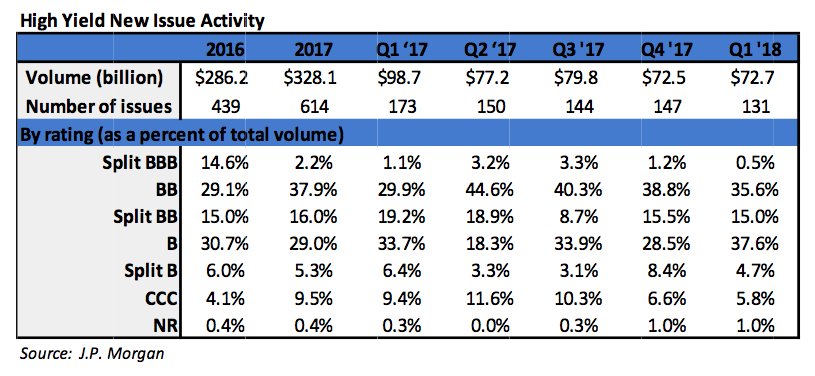 During the first quarter, the high yield primary market posted $72.7 billion in issuance. Importantly, almost three‐quarters of the issuance was used for refinancing activity. That was the highest level of refinancing since 2009. Issuance within Energy comprised just over a quarter of the total issuance. The 2018 first quarter level of issuance was relative to the $98.7 billion posted during the first quarter of 2017. The full year issuance for 2017 was $328.1 billion, making 2017 the strongest year of issuance since the $355.7 posted in 2014.
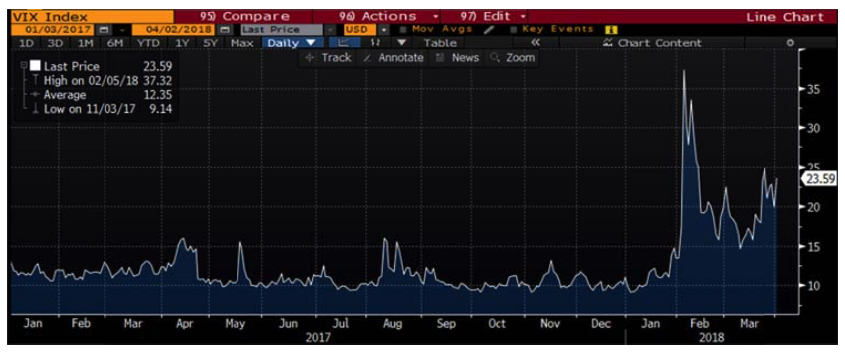 The chart to the left is sourced from Bloomberg and is the Chicago Board Options Exchange Volatility Index (“VIX”). The VIX is a market estimate of future volatility in the S&P 500 equity index. It is quite clear that the market has entered a period of higher volatility. In fact, the equity market through the first quarter of 2018 is already much more volatile than all of 2017 as measured by the number of positive and negative 1% days.iv In addition to the volatility witnessed throughout the markets during the first quarter, there have been a few transitions in high profile government posts as well. Jerome Powell began a four‐year term as Chair of the Federal Reserve following the end of Janet Yellen’s single term in that role; economist Larry Kudlow succeeded to director of the National Economic Council after Gary Cohn’s resignation; and Mike Pompeo and John Bolten were nominated as Secretary of State and National Security Adviser, respectively, after Rex Tillerson and HR McMaster were dismissed from the roles.
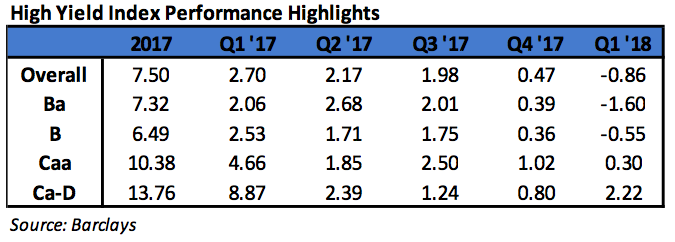 Being a more conservative asset manager, Cincinnati Asset Management remains significantly underweight CCC and lower rated securities. For the first quarter, that focus on higher quality credits was a detriment as our High Yield Composite gross total return underperformed the return of the Bloomberg Barclays US Corporate High Yield Index (‐1.83% versus ‐0.86%). The higher quality credits that were a focus tended to react more negatively to the interest rate increases. This was an additional consequence also contributing to the underperformance. Our credit selections in the food & beverage and home construction industries were an additional drag on our performance. However, our credit selections in the cable & satellite and leisure industries were a bright spot in the midst of the negative first quarter return.


