Fund Flows & Issuance: According to a Wells Fargo report, flows week to date were $0.4 billion and year to date flows stand at -$34.0 billion. New issuance for the week was $10.2 billion and year to date HY is at $131.2 billion, which is -22% over the same period last year.
(Bloomberg) High Yield Market Highlights
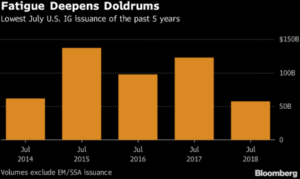
- The primary market looks set to hibernate for the rest of this month.
- Starwood’s $300 million five-year senior notes offering has not finalized terms yet, may price today
- Investors continued to vote for junk bonds with an inflow for the week ended August 15, the third consecutive positive week
- Retail funds have seen inflows in five of the last six weeks
- Yields fell, spreads were steady, stocks rebounded, VIX dropped, commodities recovered and oil rose slightly
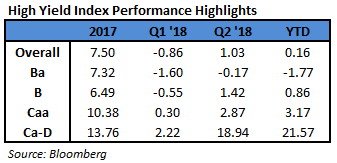
- CCCs beat single-Bs and BBs, with a YTD return of 4.16
(PR Newswire) Aircastle Corporate and Senior Unsecured Credit Ratings Upgraded to Baa3 by Moody’s
- Aircastle announced that Moody’s Investors Service has raised the Company’s corporate family and senior unsecured credit ratings to Baa3 from Ba1 based on Aircastle’s improved performance prospects, reduced fleet risk, conservative capital position and effective liquidity management.
- Mike Inglese, Aircastle’s Chief Executive Officer, stated, “Aircastle is now part of a select group of global aircraft leasing companies with investment grade credit ratings from all three major rating agencies. We are very pleased that Moody’s, S&P and Fitch recognize the strength of Aircastle’s business platform and our unique position in the industry.” Mr. Inglese continued, “As the leading investor in the secondary aircraft market, Aircastle is positioned to continue to grow in a disciplined and profitable manner. We believe that three investment grade credit ratings will substantially broaden Aircastle’s liquidity base and funding access, and should enable us to efficiently raise competitively priced capital in the global markets to further drive profitable growth.”
(Company Filing) Dish CFO resigns
- Mr. Steven E. Swain notified DISH Network that he was resigning as Senior Vice President and Chief Financial Officer effective August 22, 2018.
- The Boards of Directors designated Paul W. Orban as the principal financial officer.
- Mr. Orban, age 50, has served as our Senior Vice President and Chief Accounting Officer since December 2015 and is responsible for all aspects of our accounting and tax departments including external financial reporting, technical accounting policy, income tax accounting and compliance and internal controls for DISH Network. Mr. Orban served as our Senior Vice President and Corporate Controller from September 2006 to December 2015 and as our Vice President and Corporate Controller from September 2003 to September 2006. Since joining DISH Network in 1996, Mr. Orban has held various positions of increasing responsibility in our accounting department. Prior to DISH Network, Mr. Orban was an auditor with Arthur Andersen LLP. Mr. Orban is a certified public accountant and has an undergraduate degree in Accounting from the University of Colorado.
(Investor’s Business Daily) Diamondback Energy Expands In Permian With Energen Buy
- Shale producer Diamondback Energy agreed to buy Energen in an all-stock deal valued at $9.2 billion, setting up Diamondback to be the Permian Basin’s No. 3 producer.
- Under the deal, which includes Energen’s net debt of $830 million, shareholders will receive 0.6442 shares of Diamondback common stock for each share of Energen common stock. This represents a price of $84.95 per share based on the closing price of Diamondback common stock on Monday. The transaction has been unanimously approved by the boards of directors of each company.
- Earlier this month, Diamondback agreed to acquire all leasehold interests and related assets of Ajax Resources for $900 million in cash and 2.58 million shares of common stock.
- Management said the Energen buy should close at the end of Q4 and will add to per-share earnings and per-share cash flow in 2019, supporting increases in capital returned to shareholders. But Diamondback will maintain its dividend and assess growth in capital returns in 2019. Earlier this year, the company initiated an annual cash dividend of 50 cents a share.
- “This transaction represents a transformational moment for both Diamondback and Energen shareholders as they are set to benefit from owning the premier large-cap Permian independent with industry leading production growth, operating efficiency, margins and capital productivity supporting an increasing capital return program,” said Diamondback Energy CEO Travis Stice in a statement.
(Bloomberg) Amazon Is Said to Be in Running to Buy Landmark Movie Chain
- Amazon.com Inc. is in the running to acquire Landmark Theaters, a move that would vault the e-commerce giant into the brick-and-mortar cinema industry, according to people familiar with the situation.
- The company is vying with other suitors to acquire the business from Wagner/Cuban Cos., which is backed by billionaire Mark Cuban and Todd Wagner, according to the people, who asked not to be identified because the discussions are private. The chain’s owners have been working with investment banker Stephens Inc. on a possible sale, the people said. No final decisions have been made, and talks could still fall apart.
- Pushing into movie theaters would follow Amazon’s expansion into myriad other forms of media, including a film and TV studio and music service. With Landmark, it gets a chain focused on independent and foreign films with more than 50 theaters in 27 markets, including high-profile locations in New York, Philadelphia, Chicago, Los Angeles and San Francisco.
- Landmark’s theaters are known for art-house fare, and some high-end locations include coffee bars or lounges, setting them apart from the typical movie experience.
- “This is probably a move to get broader distribution of film content,” said Leo Kulp, an analyst with RBC Capital Markets LLC. “Netflix had been discussed as a potential buyer of Landmark for a similar reason.”
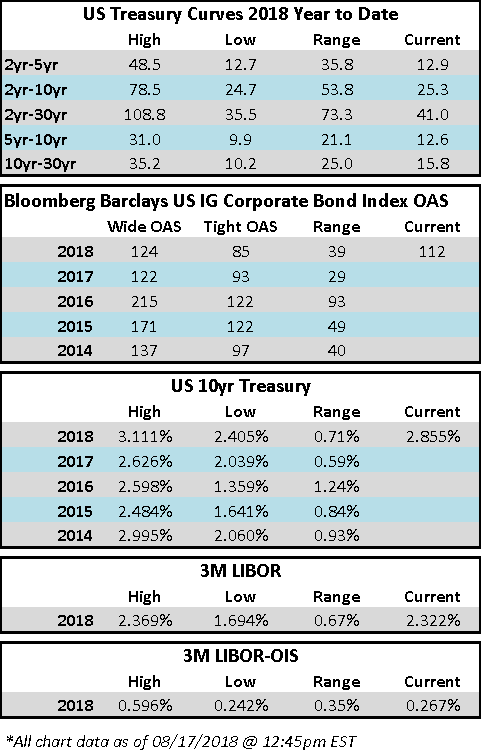
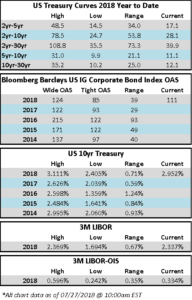

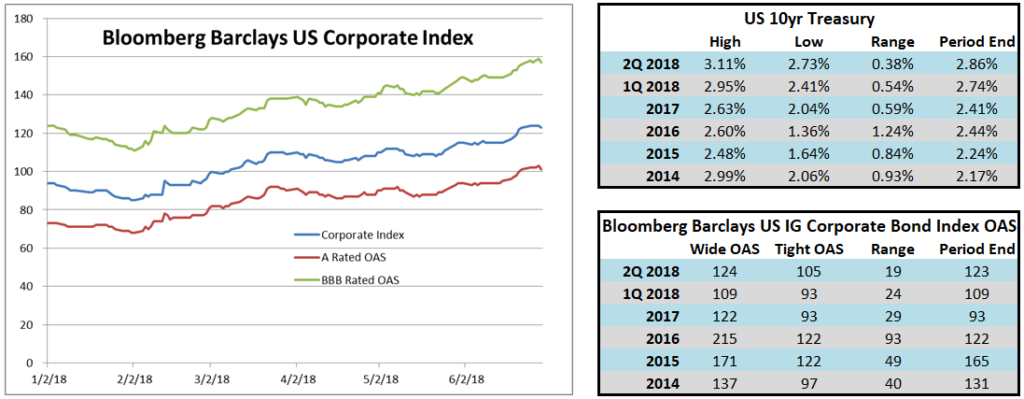


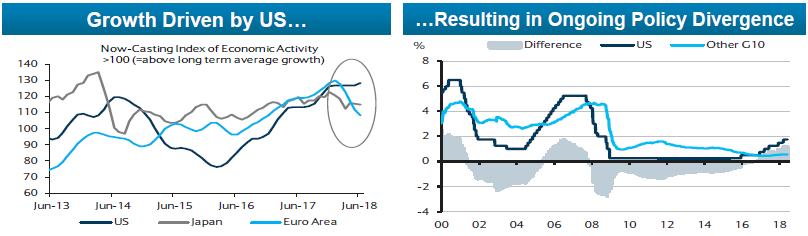
 The Federal Reserve held two meetings during Q2 2018. The Federal Funds Target Rate was raised at the June 13
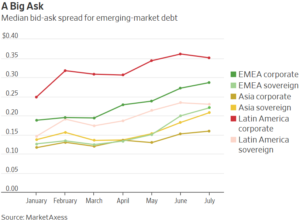
 While the Fed continues a less accommodative posture, other Central Banks aren’t necessarily following suit. The Bank of Japan is still buying an annualized JPY45 trillion of Japanese Government Bonds (“JGB’s”) and targeting a JGB yield of 0%.