
CAM High Yield Weekly Insights
(Bloomberg) High Yield Market Highlights
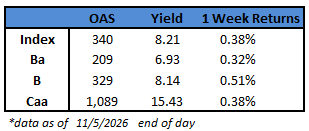
- US junk bonds tumbled Thursday, a day after posting their biggest gains in six months, as renewed fears over the AI trade routed equities and drove investors away from risk. Yields jumped and spreads widened to 340 basis points, matching a 17-month high reached last week, while the S&P 500 plunged the most since the April 2025 tariff shock.
- The selloff affected all ratings, as Democratic control of Congress stoked fears of tighter regulation that could restrain the rapid expansion of data centers, challenge lofty valuations and curb the AI-driven investment boom.
- BB spreads widened 14 basis points to 209, a seven-month high, and yields rose to 6.93%, fueling the biggest one-day loss in three weeks.
- However, the primary market defied the broader selloff, with three deals pricing for more than $2b and lifting the week’s issuance tally to nearly $10b
- US junk bonds may stage a modest rebound from Thursday’s selloff as steady oil prices and firmer US equity futures offer some support to risk-on sentiment.
(Bloomberg) US Adds 165,000 Jobs, Topping All Forecasts in Broad Advance
- US job growth surged in October and the unemployment rate edged lower, a sign of labor-market strength in an expanding economy.
- Nonfarm payrolls increased 165,000 last month, topping all forecasts, after an upward revision to the prior two months, according to Bureau of Labor Statistics data out Friday. The unemployment rate fell to 4.1%.
- Employers across a broad range of sectors added jobs, including in professional and business services, healthcare and manufacturing. Overall private-sector payroll growth was the strongest since March.
- Resilient consumer spending and strong business investment have supported demand and boosted corporate profits this year, encouraging companies to add more workers. Job growth has been uneven from month to month, but overall hiring has been strong enough to keep the unemployment rate low.
- Federal Reserve officials will see one more jobs report and a full slate of inflation data before their next meeting in December. Investors expect them to raise interest rates at that gathering to counter inflation, following an increase in September and a subsequent decision to leave rates unchanged in October.
- Fed Chairman Kevin Warsh last week described employment conditions as “quite positive” and said the central bank was focused on prices. The yield on 2-year Treasury notes rose and S&P 500 futures remained higher following the release.
- Healthcare and social assistance employers added about 55,000 workers to payrolls in October, the most in six months. That sector has been the biggest driver of job growth in recent years.
- Spending on data centers and demand for AI-related infrastructure has supported construction and manufacturing employment this year. Friday’s report showed that nonresidential construction firms continued to add jobs, even as broader construction payrolls were weighed down by losses in residential building.
- Factory headcount also saw solid gains, with computer and electronic product manufacturing firms in particular adding the most jobs in four years.
- Employment in the information and financial activities sectors, which have seen some of the fastest rates of job loss and AI adoption this year, showed tentative signs of stabilization in October.
- Goldman Sachs Group Inc. economists, in a note published this week, said “AI’s labor market impact has become increasingly visible in recent months,” with “higher adoption associated with weaker job growth and higher unemployment” across nonmanufacturing industries.
- The report also suggested the labor market is generating little wage pressure. Average hourly earnings advanced 3.1% from a year earlier, matching the slowest pace since 2021. On a monthly basis, however, they rose 0.4%, topping forecasts.
- The wage figures highlight a key source of voter frustration in this week’s midterm elections. While the unemployment rate has been low, pay hasn’t kept up with inflation throughout most of 2026.
- The participation rate — the share of the population that is working or actively looking for work — edged up to 61.9% in October, the highest since March. A broad measure of unemployment also rose as the ranks of those working part-time for economic reasons jumped to a six-month high.
- Measures of long-term unemployment worsened, with the median duration of a jobless spell reaching 11.9 weeks, the longest since 2021. Labor-market turnover has been historically low for much of the last few years, which has made it difficult to find new jobs and led many to feel either locked out or stuck in place.
This information is intended solely to report on investment strategies identified by Cincinnati Asset Management. Opinions and estimates offered constitute our judgment and are subject to change without notice, as are statements of financial market trends, which are based on current market conditions. This material is not intended as an offer or solicitation to buy, hold or sell any financial instrument. Fixed income securities may be sensitive to prevailing interest rates. When rates rise the value generally declines. Past performance is not a guarantee of future results.