
CAM High Yield Weekly Insights
(Bloomberg) High Yield Market Highlights
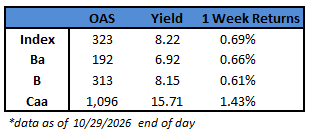
- On Thursday, US junk bonds stalled after a three-day rally as strong economic data and a renewed tech selloff pushed yields higher and spreads A day after the Federal Reserve held rates steady, data showed the US economy grew at its fastest pace in a year in the third quarter, while the Fed’s preferred inflation gauge rose the most in six months.
- Strong growth data revived inflation fears, while lingering skepticism over the AI trade and returns on massive investments added to the risk-off tone.
- BB spreads climbed to 192 basis points and yields rose to 6.92% on Thursday, reversing three days of declines
- CCC spreads widened 19 basis points to 1,096 and yields rose 13 basis points to 15.71%
- The risk-off backdrop brought new issuance to a crawl, as elevated yields, wider spreads, rising oil prices and persistent doubts over returns on AI investments kept borrowers on the sidelines
- October volume limped to about $15b, making it the second-slowest month of the year after the August lull. Issuance averaged just $3.5b a week over the final four weeks.
(Bloomberg) Fed Holds Fire as Warsh Telegraphs More Hikes Without Saying It
- Federal Reserve Chairman Kevin Warsh on Wednesday left the central bank on track to raise interest rates again this year, even as he stuck to his refusal to offer any explicit guidance on the future path of policy.
- Operating within his self-imposed communication boundaries, Warsh used his assessment of a strong economy and warnings over persistent inflation to signal the Fed’s job is not yet done. The message reinforced expectations that officials will raise borrowing costs in December — after holding them steady Wednesday — with the potential for another increase in early 2027. Still, Warsh was careful to leave his options open.
- Warsh opened his Wednesday press conference by cataloging the economy’s strengths: first-half GDP revised up to 2.4%, third-quarter growth tracking north of 3%, double-digit gains in business investment and near-historic lows in jobless claims. That underlying resilience, Warsh argued, gives the Federal Open Market Committee the room it needs to train its focus squarely on an inflation rate that has lingered above the Fed’s 2% target for nearly six years.
- He also underlined the Fed’s willingness to take action, pointing as evidence to their unanimous decision in September to hike for the first time in three years. And he emphasized that the Fed would benefit from the “information-rich interval” between now and its December meeting.
- “It’s our responsibility to get inflation down,” Warsh said following the central bank’s 10-2 vote to hold the benchmark federal funds rate in a range of 3.75% to 4%. “That’s the reason the FOMC’s discussion over the last couple of days focused mainly on the price stability side of our remit.”
- Several economists said they expect the Fed to hike a total of two more times, effectively reversing the cuts they made in late 2025 to shore up a wobbly labor market. As of Wednesday afternoon, investors were expecting rate hikes in December and March, according to pricing in futures contracts.
- The decision to hold rates yielded dissents from Fed Governor Lisa Cook and Cleveland Fed President Beth Hammack, who would have preferred to hike. Some policymakers who have been warning about high inflation, including Dallas Fed President Lorie Logan and Minneapolis Fed President Neel Kashkari, voted with the majority, but Nationwide Chief Economist Kathy Bostjancic said they likely supported the decision because they expect the Fed to raise rates again in December.
- Even with a December hike on the table, Warsh made clear he’s not trying to choke off growth, suggesting he wants to curb inflation without slowing down business investment or hiring.
- Asked how much inflation is being driven by demand from the artificial intelligence build-out, Warsh pivoted, pointing instead to unmeasured gains in underlying worker and technological efficiency.
- “Is the economy running too hot? Is the economy running too strong? That isn’t the judgment of most of my colleagues,” Warsh said. “Economic growth is higher, but that doesn’t tell me that economic growth is somehow causing inflation, making our job harder.”
- The Fed’s goal “isn’t to throw sand in the gears of the economy and throw people out of work,” he added.
- Where Warsh sounded more cautious — acknowledging that credit conditions had tightened since the Fed raised rates in September — he stopped short of declaring that market conditions are tight enough to slow growth on their own.
- “While overall financial conditions are tighter, I’m unwilling and unable to call them tight,” Warsh said.
This information is intended solely to report on investment strategies identified by Cincinnati Asset Management. Opinions and estimates offered constitute our judgment and are subject to change without notice, as are statements of financial market trends, which are based on current market conditions. This material is not intended as an offer or solicitation to buy, hold or sell any financial instrument. Fixed income securities may be sensitive to prevailing interest rates. When rates rise the value generally declines. Past performance is not a guarantee of future results.