
CAM High Yield Weekly Insights
(Bloomberg) High Yield Market Highlights
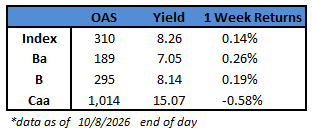
- US junk bonds extended their losses for a second straight session on Thursday as yields climbed and risk premiums increased on renewed doubts over the durability and costs of AI-fueled growth. Persistent inflation concerns, stoked by elevated energy costs, added to the risk-off tone.
- Yields surged to within nine basis points of their 17-month high of 8.35%, while spreads closed within striking distance of their six-month peak of 318.
- The weakness cut across ratings, with CCCs bearing the brunt of the selloff. Yields on the riskiest part of the market surged to a fresh four-year high of 15.07%, while spreads widened to a distressed 1,014 basis points, the highest since March 2023
- Credit has found some stability at wider levels, but rates remain the key driver for sentiment, Barclays strategists Brad Rogoff and Dominique Toublan wrote on Friday. Supply-demand technicals should improve as rates rise, and with fundamentals remaining solid for the majority of issuers, rates volatility should keep spreads in a slightly higher range, they added
- A resilient economy, tight spreads and attractive yields continue to support issuance, although the pace has slowed after $14b was priced last week, and $18b the week before that
- Five borrowers launched debt sales this week. Four priced for a modest $3.4b taking the month’s tally to just $4b.
(Bloomberg) US Consumer Sentiment Falls to Five-Month Low in October
-
- US consumer sentiment fell in early October and views of current economic conditions hit an all-time low as inflation weighed on households.
- The University of Michigan’s preliminary sentiment index decreased to 46.3, the lowest reading since May, according to the survey released Friday. That was below the median estimate of 47.6 in a Bloomberg survey of economists.
- The current conditions gauge sank to 44.7, the lowest on record, from 50.9 in the previous month. The expectations index rose to 47.3 from 46.3, the first increase since July.
- Consumer sentiment continued to worsen as gasoline prices remained elevated, borrowing costs rose and hiring slowed.
- Consumers expect prices to rise 4.7% over the next year, up slightly from 4.6% in the previous month. They also saw costs rising at an annual rate of 3.5% over the next five to 10 years, slightly more than what consumers estimated in September.
- Higher fuel prices are weighing on consumers already frustrated with persistent inflation and the rising cost of living. In recent months, overall price increases have been outpacing pay gains, further pressuring household budgets.
- Sentiment of lower-income consumers and those with smaller stock portfolios dropped steeply this month, Joanne Hsu, director of the survey, said in a statement. And increases in sentiment among Democrats and Republicans were offset by a decline among independents.
- “Despite their differences, consumers of all political identifications agree that the outlook for the economy has softened since the beginning of the year prior to the Iran conflict,’’ Hsu said.
- While consumer sentiment has been historically weak much of this year, spending has remained healthy. A stable labor market and buoyant stock market are supporting outlays on a wide range of goods and services.
- Consumers’ perception of their current financial situation held steady this month, though their view of buying conditions for durable goods fell to a record low due to concerns over higher interest rates.
- The survey period includes responses from Sept. 22 to Oct. 5.
- A special report on consumers’ response to higher gasoline prices released Friday found only about 31% expect to spend as usual over the coming year. Just over half said they would cut back spending on items such as household goods, cars, dining out and vacations.
This information is intended solely to report on investment strategies identified by Cincinnati Asset Management. Opinions and estimates offered constitute our judgment and are subject to change without notice, as are statements of financial market trends, which are based on current market conditions. This material is not intended as an offer or solicitation to buy, hold or sell any financial instrument. Fixed income securities may be sensitive to prevailing interest rates. When rates rise the value generally declines. Past performance is not a guarantee of future results.