
2026 Q3 Investment Grade Quarterly
Third Quarter Commentary & Outlook
October 2026
It was a difficult environment for the investment grade bond market during the third period of the year. Wider credit spreads and meaningfully higher interest rates led to negative returns for the asset class.

Third Quarter Recap
The third quarter brought increased volatility with each passing day, and especially in the final few weeks of the period. Although spreads were modestly wider, they traded within a remarkably tight range and were quite stable until the very end of the quarter. The option adjusted spread (OAS) for the Bloomberg US Corporate Bond Index (The Index) opened the period at 74 and moved to an OAS of 80 at quarter-end.
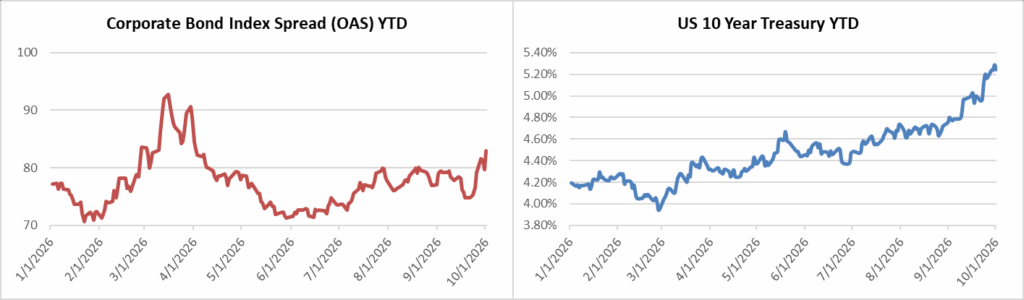
Interest rates were the culprit behind most of the headwinds during the quarter, as Treasury yields inched higher throughout September. By quarter-end, the 2yr, 5yr and 10yr Treasuries had moved 72, 86, and 82 basis points higher, respectively. The 10yr Treasury closed at 5.29% on the last day of the quarter, marking its highest level since 2002.
New World Order
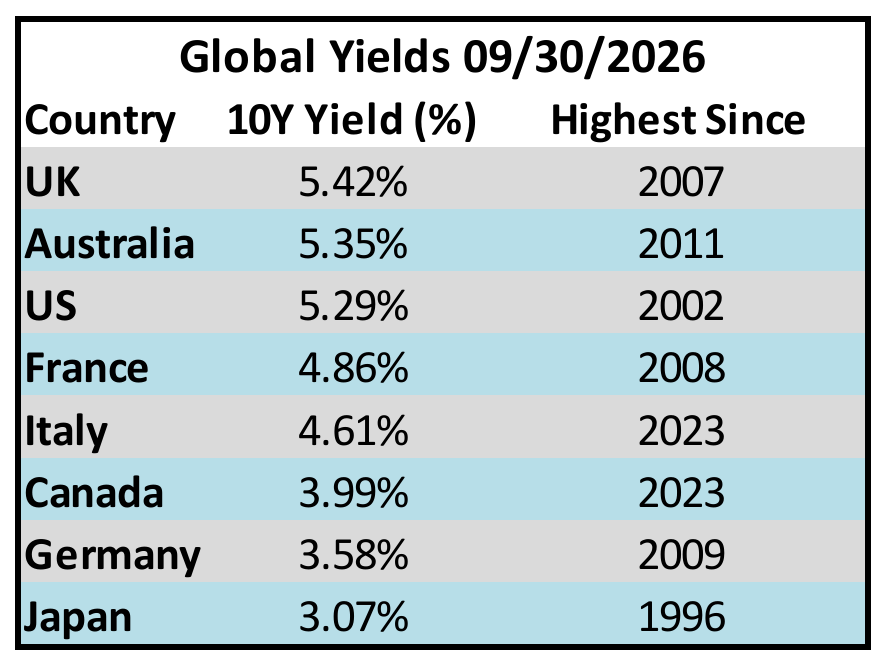
Higher yields are not a uniquely American phenomenon. Numerous developed global economies have also seen yields rise to multiyear highs. In Japan, yields have reached a generational high. There are dozens of factors that are contributing to the rise in global yields; in some cases, these are idiosyncratic issues related to individual economies, but the spike in oil prices has been a major contributor to higher rates across the globe.
Looking specifically at investment grade credit, the yield to maturity for The Index closed the quarter above 6%.
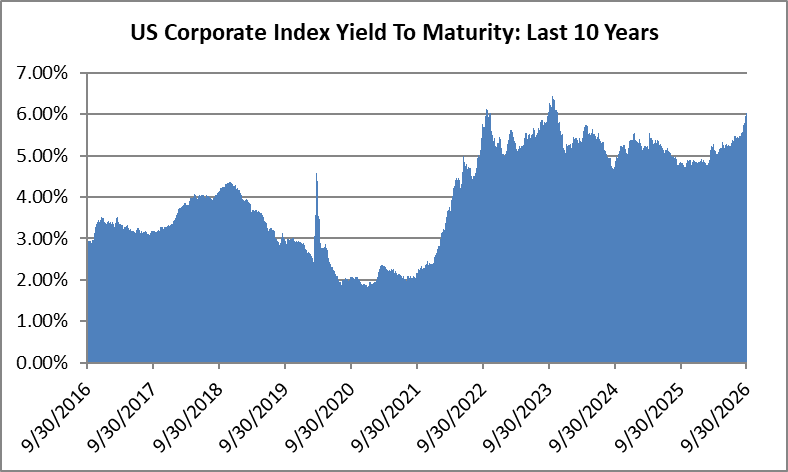
The Index has only closed above 6% 41 times (1.61%) over the course of the past decade. Going back over the past 20 years, The Index has closed above 6% 372 times out of a possible 5,054 trading days (7.36% of the time). The 20-year period encompasses the Great Financial Crisis of 2007-2009. The Index closed as high as 9.09% during the worst of the GFC.
While recent bouts of interest rate volatility present challenges for short term performance, the level of yield available without the need to incur much credit risk or duration risk leaves us optimistic about returns over longer time horizons.
No Bad Bonds, Just Bad Prices
We have written at length throughout the year about the volume of issuance within the investment grade primary market, and it remains on a record-shattering pace. New issuance presents opportunities for investors who are able to adequately assess risk-reward. Companies often have to offer a new issue “concession” to provide incentive for investors to buy their new bonds. This comes in the form of pricing the bonds at a spread discount to the existing debt of the company, or that of suitable comparable companies, if the issuer has no outstanding bonds.
For a straight refinance of existing debt from a solid IG-rated company, the new issue concession might be a mere 3-5 basis points, which could well be enough compensation for the risk. For a large debt issuance to fund M&A with some questions about the credibility of the deleveraging plan and/or the likelihood of projected synergy realization, then the concession will likely be much larger. Last quarter we wrote about SpaceX’s inaugural $25bln debt issuance and its woeful performance. This quarter it was Paramount Skydance that saw its newly minted bonds flounder. In the final days of the third quarter, the company sold $30bln of investment-grade debt, $12.4bln of junk bonds and $9.46bln of loans.i
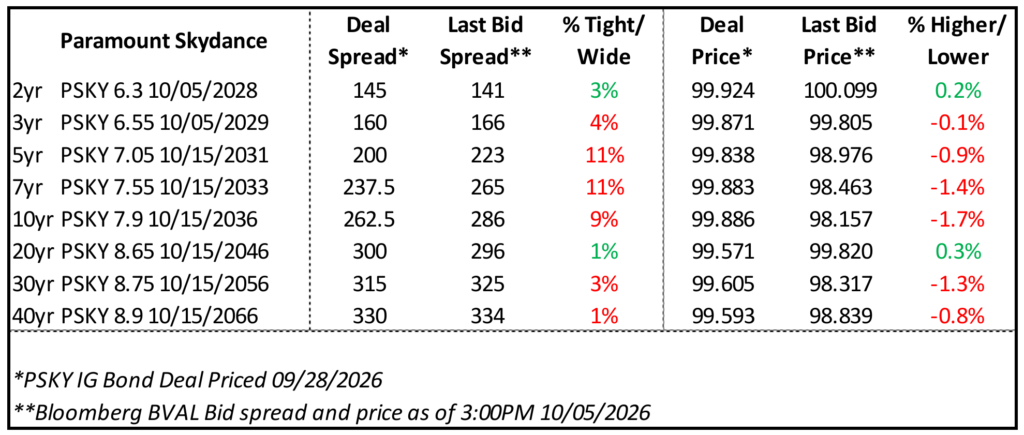
According to data compiled by Bloomberg, investors lost more than $100 million within hours of the bond deal being completed.ii The bonds have since recovered some of their value, but most maturities remain underwater relative to where they priced initially. Much of the problem with this particular deal stemmed from the fact that it contained a high-yield component and a leveraged loan component. The junk-rated riskier portion of the deal was not properly priced, in our opinion, which caused the investment-grade portion of the deal to underperform in sympathy. As an active bond manager that has corporate credit strategies across the entire rating spectrum, we are uniquely positioned to evaluate situations like these. The investment banks that syndicate debt offerings are working for the issuing company, not for investors. It is the responsibility of investors and fiduciaries to determine if the compensation adequately compensates for the risk of any particular bond offering.
FOMC Spotlight
There were two FOMC decisions during the quarter. The Fed held rates steady on July 29th before delivering a “credibility hike” on September 16th. Inflation has been running above target for too long and Warsh telegraphed a strong possibility of a hike in the weeks leading up to the September meeting, making the decision a foregone conclusion. We still have questions about the effectiveness of what we expect to be an abbreviated tightening cycle, and we find it hard to envision a scenario where the Fed delivers more than one or two additional hikes. If it ends up being a three-hike cycle, then that would effectively remove the three “insurance cuts” that the Fed delivered at the end of 2025.
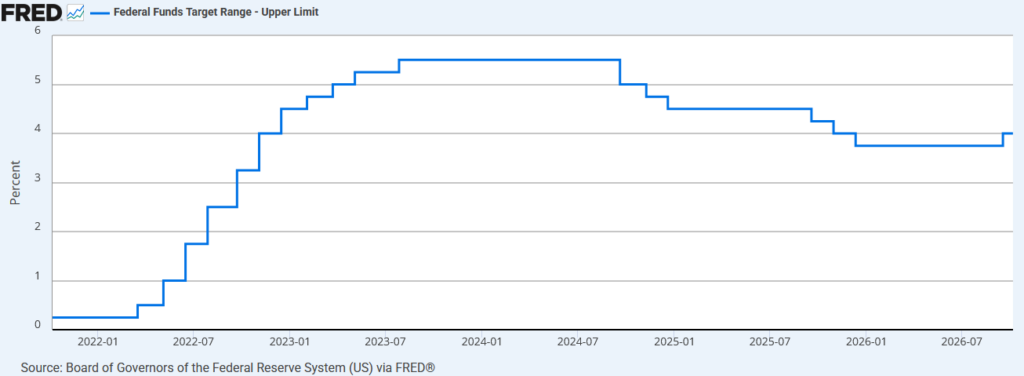
We remain skeptical about the efficacy of tightening financial conditions because higher policy rates target demand by increasing the cost of borrowing funds; however, current inflationary pressures are related to supply. The level of the FOMC policy rate has no effect on geopolitical turmoil and the resulting impacts on energy costs. At the end of the third quarter, West Texas crude was up nearly 60% YTD and Brent Crude had increased almost 70%. U.S. diesel prices are near all-time highs. These factors are well outside of the Fed’s control. If the U.S. and Iran can reach an agreement, inflationary pressures could ease rapidly. As of early October, Fed Funds Futures were pricing a +19.4% chance of a hike at the October 28th meeting and a +83.6% chance at the December 9th meeting.iii
Better Times on The Horizon
It wasn’t an enjoyable quarter from a total return perspective, but we think it will be a blip on the radar over the long haul. The compensation currently afforded by intermediate-maturity investment grade corporate bonds is extremely attractive relative to any period in the recent past. Importantly, these yields are available without requiring investors to take excessive duration or credit risk. The investment-grade credit market is healthy and functioning at a high level. These factors allow bonds to serve as a powerful tool in the overall asset allocation of any investor.
We appreciate your interest and the trust that you have placed in our team to manage your fixed income investments.
This information is intended solely to report on investment strategies identified by Cincinnati Asset Management. Opinions and estimates offered constitute our judgment and are subject to change without notice, as are statements of financial market trends, which are based on current market conditions. This material is not intended as an offer or solicitation to buy, hold or sell any financial instrument. Past performance is not a guarantee of future results. Gross of advisory fee performance does not reflect the deduction of investment advisory fees. Our advisory fees are disclosed in Form ADV Part 2A. Accounts managed through brokerage firm programs usually will include additional fees. Returns are calculated monthly in U.S. dollars and include reinvestment of dividends and interest. The Index is unmanaged and does not take into account fees, expenses, and transaction costs. Index returns and related data such as yields and spreads are shown for comparative purposes and is based on information generally available to the public from sources believed to be reliable. No representation is made to its accuracy or completeness.
The information provided in this report should not be considered a recommendation to purchase or sell any particular security. Different types of investments involve varying degrees of risk, and there can be no assurance that any specific investment will either be suitable or profitable for a client’s portfolio. Fixed income investments have varying degrees of credit risk, interest rate risk, default risk, and prepayment and extension risk. In general, bond prices rise when interest rates fall and vice versa. This effect is usually more pronounced for longer-term securities. There is no assurance that any securities discussed herein have been held or will be held in an account’s portfolio at the time you receive this report or that securities sold have not been repurchased. The securities discussed do not represent an account’s entire portfolio and, in the aggregate, may represent only a small percentage of an account’s portfolio holdings, if any. It should not be assumed that any of the securities transactions or holdings discussed were or will prove to be profitable, or that the investment decisions we make in the future will be profitable or will equal the investment performance of the securities discussed herein. Upon request, Cincinnati Asset Management will furnish a list of all security recommendations made within the past year.
Additional disclosures on the material risks and potential benefits of investing in corporate bonds are available on our website: https://www.cambonds.com/disclosure-statements/
i Bloomberg, September 30 2026, “Paramount Wraps Up $52 Billion Debt Sale to Fund Warner Buyout”
ii Bloomberg, October 1 2026, “Bond Traders Lash Out at BofA, Citi as Paramount’s Debt Craters”
iii Bloomberg, October 6 2026 2:42 PM EST, “World Interest Rate Probability”