
CAM High Yield Weekly Insights
(Bloomberg) High Yield Market Highlights
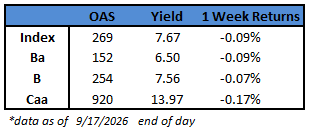
- After the Federal Reserve delivered a quarter-point rate hike and oil prices retreated for a second consecutive session, there was a bit of optimism that inflation can be contained without disrupting growth. The Federal Reserve, in fact, lifted growth forecasts for 2026 and 2027 to 2.3% and 2.4%, respectively, from 2.2% and 2.3%.
- The Fed move bolstered the primary market as spread compression continued, while higher yields powered robust demand.
- The primary market is expected to see a steady stream of supply powered by tight spreads, steady yields against the backdrop of steady growth, strong corporate balance sheets, and low defaults
(Bloomberg) Fed Raises Rates to Curb Inflation
- The Federal Reserve raised interest rates by a quarter percentage point and penciled in an additional hike later this year, steps aimed at containing inflation.
- “We removed a dose of accommodation so that financial and credit conditions would be more consistent with our ultimate objectives,” Warsh said during a press conference following the decision. “Today’s action starts to show we’re serious about this, and we will deliver on the price stability objective.”
- The Federal Open Market Committee voted unanimously to increase the benchmark federal funds rate to a range of 3.75% to 4% on Wednesday. It was the US central bank’s first rate increase since July 2023.
- In his remarks to reporters, Warsh restated his concerns over inflation, saying too many categories of products and services were showing annualized price gains above 3% on a 6- and 12-month basis.
- “This summer’s inflation readings do not tell me that underlying trends have meaningfully improved,” he said.
- His comment on removing a “dose of accommodation” also drew attention from Fed watchers.
- “That’s hawkish. If the chair thinks policy is accommodative, then you’ve got more work to do,” said Michael Gapen, chief US economist for Morgan Stanley.
- Two-year Treasury yields — the most sensitive to the Fed’s policy — erased an earlier decline to trade at 4.73%, more than 12 basis points higher than they were before the announcement.
- “Clearly, the Fed is more concerned about inflation at the moment,” said Oscar Muñoz, chief macro strategist at TD Securities. “That’s why they hiked today, and it seems like there are more hikes in the pipeline.”
- In a new set of rate projections released Wednesday, Fed officials’ median outlook for interest rates at the end of 2026 rose to 4.1% from 3.8%, signaling growing support for a series of rate hikes.
- Sixteen officials projected at least one additional increase this year, up from six in June who saw at least two total increases in 2026. The median projection for 2027 pointed to no additional rate hikes next year. However, eight policymakers favored moving another quarter point higher by the end of 2027 compared to where rates stand now.
- As in June, when Warsh declined to submit his own forecasts, only 18 of 19 officials provided rate projections for 2026 and 2027.
- The rate increase comes after the Bureau of Labor Statistics reported last week that core inflation rose at a hotter-than-expected pace in August. That added to growing concern that inflationary pressures may be broadening beyond the temporary effect of tariffs and the Iran war’s impact on energy prices.
- Warsh emphasized how well the US economy is performing and repeated that officials don’t see broad financial conditions as restraining growth.
- “The American economy appears to be strengthening,” he said. “Given that resilience and the potential for even greater performance, an attitude of optimism is exactly what I heard inside the FOMC these last two days.”
- Warsh warned last month that inflation was not meaningfully slowing, opening the door to policy tightening.
- In the committee’s post-meeting statement Wednesday, officials again characterized inflation as elevated, yet also described the economy in positive terms.
- “Productivity growth is strong, and capital investment is robust,” officials said. “Job gains have kept pace with the workforce, and the unemployment rate has changed little.”
- Officials repeated a promise to deliver on price stability. But even with the rate hike, they pushed out by one year their expectation for when inflation would return to 2%. The median forecast now sees it reaching that level in 2029.
- Support for higher rates has been slowly building within the Fed all year. At their July meeting, officials left rates unchanged, but three regional Fed bank presidents — Lorie Logan of Dallas, Cleveland’s Beth Hammack and Minneapolis’ Neel Kashkari — dissented in favor of a rate hike.
- Minutes from that gathering showed many officials indicated policy tightening would be necessary if inflation didn’t decline.
This information is intended solely to report on investment strategies identified by Cincinnati Asset Management. Opinions and estimates offered constitute our judgment and are subject to change without notice, as are statements of financial market trends, which are based on current market conditions. This material is not intended as an offer or solicitation to buy, hold or sell any financial instrument. Fixed income securities may be sensitive to prevailing interest rates. When rates rise the value generally declines. Past performance is not a guarantee of future results.