
CAM High Yield Weekly Insights
(Bloomberg) High Yield Market Highlights
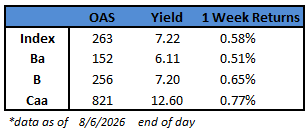
- The US junk bond rally fizzled out as uncertainty over the Strait of Hormuz fueled oil prices and expectations of a September Federal Reserve rate hike. High-yield snapped a three—day winning streak despite resilient labor market and strong productivity growth.
- The rally reversed across ratings. CCC yields jumped 20 basis points to 12.60% and spreads widened 13 basis points to 821.
- Though the rally lost some momentum on Thursday, resilient macro data, strong corporate earnings and growing evidence of AI-related benefits support risk-on sentiment, Barclays strategists Brad Rogoff and Dominique Toublan wrote on Friday
- In the primary market, just one $600m deal by OneMain Finance was priced, lifting weekly issuance to $3.3b. Four borrowers sold bonds for $2.7b on Wednesday, lifting year-to-date volume to nearly $201b
(Bloomberg) US Employers Unexpectedly Shed Jobs
- US employers unexpectedly cut jobs in July and hiring in the prior two months was revised lower, suggesting the labor market is weaker than previously thought after surprising strength earlier this year.
- Nonfarm payrolls decreased 23,000 last month following a combined 103,000 downward revision to the May and June figures, Bureau of Labor Statistics data showed Friday. The unemployment rate fell to 4.1% as labor force participation continued to slide, and wage growth slowed.
- The report suggests the labor market may be starting to falter amid rising prices and uncertainty from the Iran war, despite recent data showing strength in consumer spending and business investment. The data could also prompt the Federal Reserve to delay interest-rate increases as officials weigh inflation against risks to employment.
- US stocks opened higher and Treasury yields fell as investors reduced bets on a Fed rate hike in September. Still, upcoming reports on consumer prices — including data for July next week — could ultimately decide the Fed’s course of action next month.
- “The soft labor market report should lower market expectations for a Fed rate hike in the coming months, but the inflation reports will be the key focus for Fed officials,” Nationwide Chief Economist Kathy Bostjancic said in a note. “If inflation prints run hot for the next few months, then odds of a rate hike increase.”
- The decline in jobs was driven by cuts in government, leisure and hospitality and retail trade. Private-sector payrolls rose by 30,000 for a second month, led by healthcare and social assistance.
- Local government employers shed nearly 60,000 jobs, almost entirely in education, which can be volatile in the summer as many teachers fall off of payrolls before returning again as the school year begins. Federal government payrolls also fell.
- Leisure and hospitality employment declined to the lowest level in almost a year as restaurants and bars shed staff, suggesting the FIFA World Cup that ended July 19 didn’t provide the boost to payrolls many forecasters had anticipated.
- The report comes as high-profile companies announced layoffs throughout the month including Microsoft, Uber Technologies Inc. and Visa Inc. Payrolls in the financial activities sector, a key employer of white-collar workers seen as among the most vulnerable to artificial intelligence adoption, fell to the lowest level in four years.
- Manufacturing and construction payrolls, however, continued to climb. Many economists have pointed to the data-center buildout as a possible driver of demand for construction labor in 2026, even as homebuilding continues to be restrained by high interest rates.
- The participation rate — the share of the population that is working or looking for work — fell to 61.4%, which excluding the pandemic was the lowest since the 1970s. Among those between the ages of 25 and 54, known as prime-age workers, participation edged higher but remained near the lowest levels of the last few years.
- Purchasing power will also be a key issue heading into the November midterm elections, especially as the Iran war has further driven up the cost of living. While consumer sentiment rebounded last month, consumers’ views about their current financial situation remain below levels seen in recent years.
- Other data out this week offered better news. ADP Research said wage gains for private-sector workers who switched jobs picked up in July to the highest in almost a year. Bank of America Institute, meanwhile, found a jump in pay and job gains among lower-income households last month, and a gauge of small-business hiring plans from the National Federation of Independent Business rose to the highest level in almost four years.
- “This does not look credible to me. The numbers don’t jibe with what we’re seeing more broadly for the labor market,” said Stephen Stanley, the chief economist at Santander US Capital Markets LLC. “If the labor market had weakened as much as the June and July jobs report suggests, we’d be hearing it from Fed officials and the economy, and we’re not.”
This information is intended solely to report on investment strategies identified by Cincinnati Asset Management. Opinions and estimates offered constitute our judgment and are subject to change without notice, as are statements of financial market trends, which are based on current market conditions. This material is not intended as an offer or solicitation to buy, hold or sell any financial instrument. Fixed income securities may be sensitive to prevailing interest rates. When rates rise the value generally declines. Past performance is not a guarantee of future results.