
2026 Q1 Investment Grade Quarterly
First Quarter Commentary & Outlook
April 2026
Turmoil in the Middle East was a headwind for risk assets during the first quarter. Although investment grade credit held up better than most, wider spreads and a sell-off in Treasuries were a drag on performance.

First Quarter Recap
The first quarter was memorable for its contrast, best characterized as a benign start with a turbulent finish. January was a methodical move tighter, with the option adjusted spread (OAS) for the Bloomberg US Corporate Bond Index (The Index) opening the period at 78 before moving to 71 near the end of that month, the tightest level for credit spreads since 1998.i Spreads took a slight breather during the month of February, but remained at snug levels, trading in the 70s until the last few trading days of the month. Coordinated US-Israeli airstrikes on Iran at the end of February had repercussions for risk assets. March was the month of volatility, and while investment grade credit fared relatively well, it would not escape unscathed. The OAS on the Index traded as wide as 93 in mid-March before clawing back some momentum, finishing the period at a spread of 89.
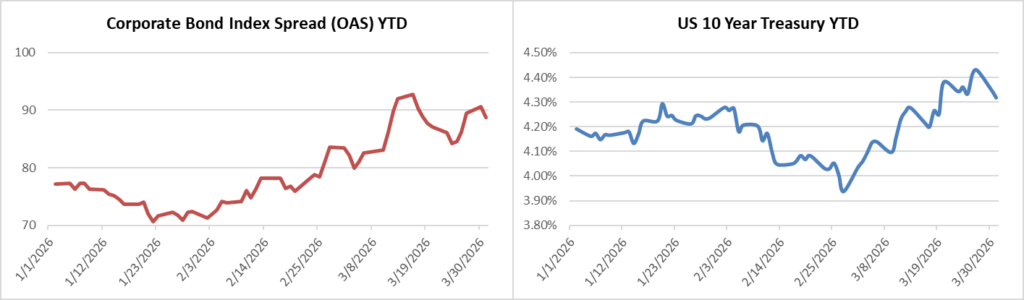
Treasuries were rangebound in January before rallying throughout February as investors seized on weak US employment data and began to anticipate multiple policy cuts by the Federal Reserve. Sentiment shifted rapidly in March as the Iran conflict sent Treasury yields sharply higher. This was a paradoxical move in rates; a hot war usually sparks a flight to safety and a rally in Treasuries but this price action was a clear response to elevated oil prices and the potential for hotter inflation. By quarter-end, the overall move in rates saw the 2yr, 5yr and 10yr Treasuries finish the period 32, 21 and 15 basis points higher, respectively. The disproportionate impact to the front end of curve was related to investor calculus around the Fed’s policy rate. Fed Funds Futures were pricing more than 2 full cuts in 2026 at the beginning of the quarter, but by quarter-end, futures were pricing zero cuts in 2026.ii
The impact of higher Treasury yields and an 11-basis point move wider in credit spreads proved too much to overcome for IG credit, leading to modestly negative total returns for the asset class during the first quarter.
Higher Yields = Downside Protection
We never like to post a negative quarter of performance but we were encouraged by the behavior of IG credit during the month of March amid an environment of extreme volatility. IG credit has historically played an important role in providing ballast to an overall portfolio allocation and we believe it delivered on that mandate by outperforming most other major asset classes. Yields remain elevated which helps to provide a margin of safety for credit investors, even in an environment where credit spreads are tighter than historical averages. The following analysis shows the approximate annual total return that an investor could anticipate in a variety of interest rate shock scenarios, both higher and lower rates. We also included data from March of 2021 to illustrate the impact that those same shocks would have had when investing at much lower all-in yields.

This was a simplistic analysis meant to isolate the impact of interest rate moves so we assumed no change in credit spreads. The reality is that, although credit spreads may start and finish a period relatively unchanged, they are moving all the time throughout each trading day. Still, this exercise illustrates the power of investing at higher interest rates. A better starting point leads to more downside protection and the potential for greater returns on the upside.
Private Credit
We have fielded questions from some of our investors about potential systemic risk from the malaise in private credit and how that might affect public bond investments. Private credit is simply one of many asset classes within the broader world of fixed income that includes ABS, MBS, CLOs, investment grade corporate bonds, high yield corporate bonds, Treasuries and municipal bonds, among others. There are very limited broader implications for the rest of the asset classes within fixed income and this holds especially true for investment grade rated companies, which do not frequently use the private credit markets as part of their capital structures.
In his book the Principles of Economics, Greg Mankiw describes a key tenet of opportunity cost: “To get one thing that we like, we usually have to give up another thing that we like. Making decisions requires trading off one goal against another.” Private credit usually offers more yield than publicly traded credit but it does so at the expense of less liquidity, more opacity, and in many cases, less diversification (look no further than the outsize exposure that some private credit lenders have to the software industry).iii Private credit is priced infrequently and at manager discretion. Public credit prices are updated within minutes of each trade. There is nothing inherently wrong with private credit; like all investments, it comes down to a matter of suitability. If an investor has a portion of a portfolio that takes a very long-term strategic view with an appropriate risk tolerance and no liquidity needs for the foreseeable future then it likely meets the litmus test in order to allocate a portion of that portfolio to private credit. According to Bloomberg estimates, investors sought to pull $13bln from over a dozen private credit funds during the first quarter but have only been able to access about $8.4bln of that amount.iv Unfortunately, it appears likely that many of these investors did not fully understand the liquidity constraints of investing in such funds.
New Issue Supply
The investment grade primary market is almost always open for business, and it lived up to that reputation during March. According to data compiled by Bloomberg, it was the 4th highest volume month ever, and the largest outside of the pandemic-era borrowing binge.v
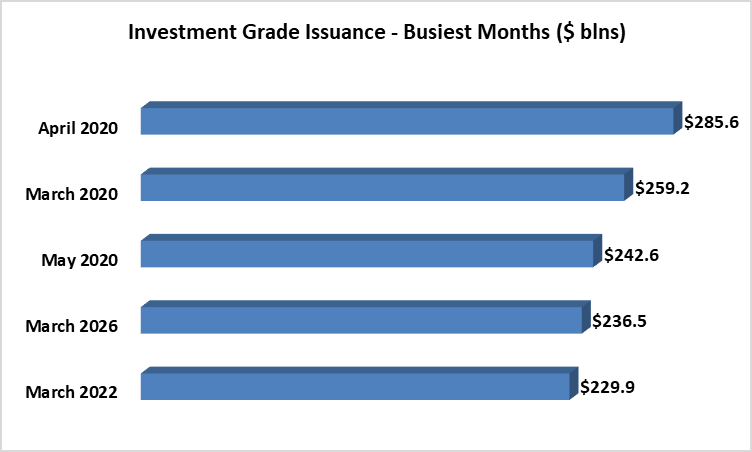
Disruption across capital markets did not dissuade borrowers and investors from meeting one another to get deals done. This high degree of functionality is one of the defining characteristics of Investment Grade as an asset class. Even during times of market stress, investors and companies almost always have access to liquidity.
Federal Reserve
There were two FOMC policy rate decisions during the quarter and at both meetings the majority of the committee elected to keep the federal funds rate unchanged. In other news, President Trump formally nominated Kevin Warsh to replace Jerome Powell as Chair of the Board of Governors when Powell’s term expires in May. Although he still has to face confirmation by the Senate, markets appeared to be content with the Warsh pick, viewing him as a safe and acceptable selection.
As we wrote earlier in this commentary, the calculus for near term rate cuts changed significantly throughout the quarter. Initially, it was a safe bet that 1-2 cuts would occur during 2026, but lately, there has been some discussion about the potential for rate hikes if inflation becomes more heated on the back of higher oil prices. Labor market data has been mixed, with an exceptionally weak employment report for the month of February followed by the strongest report since 2024 for the month of March. Given the backward-looking nature of BLS data, the health of the labor market is a lot less important now than it otherwise would have been due to the war with Iran. Bottom line, we believe the Fed is on hold until there is more progress toward a resolution with Iran. At the very least the FOMC will need several months of “post-war” economic data in order to more accurately gauge the impact of higher oil prices on the U.S. economy.
Keep it Simple
We have not responded to market volatility by making major changes to our philosophy or process. Our portfolio construction is conservative by design, and always through the lens of longer time horizon. The last thing we want for our clients is to invest in a company where we are waiting for the next headline to determine its fate. Instead, we concentrate on populating portfolios with durable businesses that can operate in a variety of economic environments. If volatility accelerates and good companies are available at significant discounts then you can expect us to be opportunistic.
We are grateful for your trust and partnership. Please do not hesitate to reach out to us to discuss the credit markets as we navigate this time of uncertainty.
This information is intended solely to report on investment strategies identified by Cincinnati Asset Management. Opinions and estimates offered constitute our judgment and are subject to change without notice, as are statements of financial market trends, which are based on current market conditions. This material is not intended as an offer or solicitation to buy, hold or sell any financial instrument. Past performance is not a guarantee of future results. Gross of advisory fee performance does not reflect the deduction of investment advisory fees. Our advisory fees are disclosed in Form ADV Part 2A. Accounts managed through brokerage firm programs usually will include additional fees. Returns are calculated monthly in U.S. dollars and include reinvestment of dividends and interest. The Index is unmanaged and does not take into account fees, expenses, and transaction costs. Index returns and related data such as yields and spreads are shown for comparative purposes and is based on information generally available to the public from sources believed to be reliable. No representation is made to its accuracy or completeness.
The return scenarios under the “Higher Yields = Downside Protection” are hypothetical and for illustrative purposes only and do not represent actual investment results. They are intended for institutional investors or financially sophisticated audiences capable of evaluating the assumptions and limitations of hypothetical performance. The analysis estimates annual total returns by combining the initial yield-to-worst with the estimated price impact of parallel changes in U.S. Treasury rates based on duration. As stated, this analysis assumes no change in credit spreads, no defaults, and no transaction costs, and does not reflect the impact of active management or security selection. Actual results may differ materially due to changes in interest rates, credit spreads, issuer fundamentals, market liquidity, and other factors. Hypothetical performance has inherent limitations and does not reflect actual trading or investor experience.
The information provided in this report should not be considered a recommendation to purchase or sell any particular security. Different types of investments involve varying degrees of risk, and there can be no assurance that any specific investment will either be suitable or profitable for a client’s portfolio. Fixed income investments have varying degrees of credit risk, interest rate risk, default risk, and prepayment and extension risk. In general, bond prices rise when interest rates fall and vice versa. This effect is usually more pronounced for longer-term securities. There is no assurance that any securities discussed herein have been held or will be held in an account’s portfolio at the time you receive this report or that securities sold have not been repurchased. The securities discussed do not represent an account’s entire portfolio and, in the aggregate, may represent only a small percentage of an account’s portfolio holdings, if any. It should not be assumed that any of the securities transactions or holdings discussed were or will prove to be profitable, or that the investment decisions we make in the future will be profitable or will equal the investment performance of the securities discussed herein. Upon request, Cincinnati Asset Management will furnish a list of all security recommendations made within the past year.
Additional disclosures on the material risks and potential benefits of investing in corporate bonds are available on our website: https://www.cambonds.com/disclosure-statements/
i Bloomberg, January 23 2026, “AI Debt Binge Is Set to Test Credit’s 1990s-Like Euphoria”
ii Bloomberg, December 31 2025 & March 31 2026, “World Interest Rate Probability”
iii The Wall Street Journal, March 29 2026, “Private Credit’s Exposure to Ailing Software Industry Is Bigger Than Advertised”
iv Bloomberg, March 26 2026, “Trapped in Private Credit, Investors Wait to Pull Out $5 Billion”
v Bloomberg, April 2 2026, “US IG ISSUANCE: Hyundai Capital America to Close Out 1Q Alone”