
2026 Q1 High Yield Quarterly
First Quarter Commentary & Outlook
April 2026
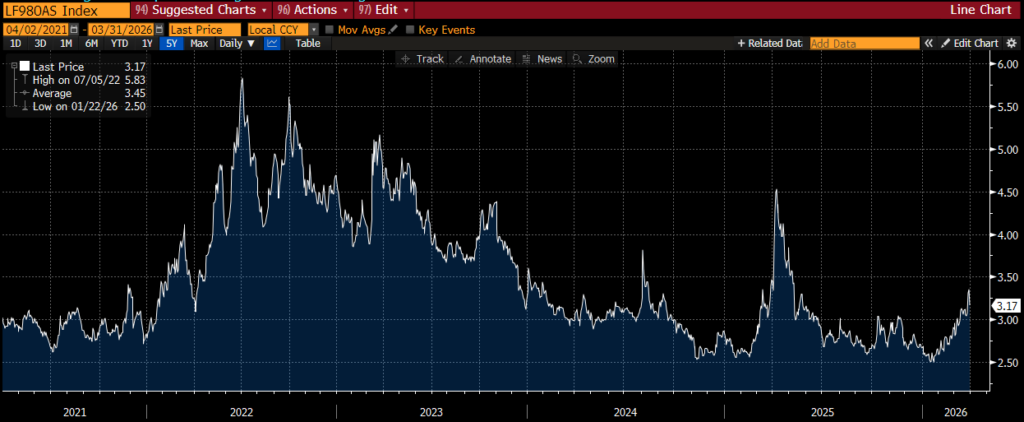
In the first quarter of 2026, the Bloomberg US Corporate High Yield Index (“Index”) return was -0.50%, and the S&P 500 index return was -4.35% (including dividends reinvested). Over the period, while the 10 year Treasury yield increased 15 basis points, the Index option adjusted spread (“OAS”) widened 51 basis points moving from 266 basis points to 317 basis points.
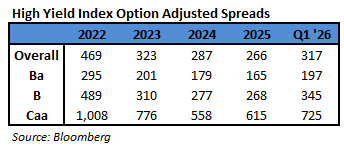
With regard to ratings segments of the High Yield Market, BA rated securities widened 32 basis points, B rated securities widened 77 basis points, and CCC rated securities widened 110 basis points. The chart below from Bloomberg displays the spread move of the Index over the past five years. For reference, the average level over that time period was 345 basis points.
The sector and industry returns in this paragraph are all Index return numbers. The Index is mapped in a manner where the “sector” is broader with the more specific “industry” beneath it. For example, Energy is a “sector” and the “industries” within the Energy sector include independent energy, integrated energy, midstream, oil field services, and refining. The Energy, Natural Gas, and Utilities sectors were the best performers during the quarter, posting returns of 2.54%, 0.99%, and 0.13%, respectively. On the other hand, Finance Companies, Banking, and Transportation were the worst performing sectors, posting returns of -2.89%, -2.75%, and -2.41%, respectively. At the industry level, refining, independent energy, and oil field services all posted the best returns. The refining industry posted the highest return of 4.38%. The lowest performing industries during the quarter were packaging, paper, and life insurance. The -4.80% posted by the packaging industry was the lowest return by any industry.
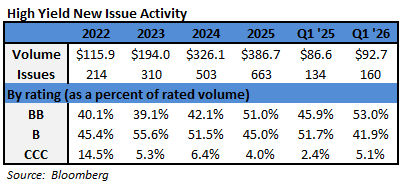
After the very strong issuance of 2025, Q1 posted a robust $92.7 billion in new issuance. Of the issuance that did take place during Q1, Communications took 22% of the market share followed by Discretionary at 16% share, and Financials at 14% share.
The Federal Reserve held the Target Rate steady at the January and March meetings. There was no meeting held in February. The present debate at the FOMC definitely favors the concern of inflation remaining above target. After the March meeting, Chair Powell commented, “The thing that’s really important that we see this year is progress on inflation. If we don’t see that progress, then you won’t see the rate cut.”i The Fed dot plot shows a median cut of 25 basis points for 2026. Currently, market participants are pricing in an implied rate move of 7 basis points in cuts for 2026.ii The inflation worry at the Fed is even before contemplating any surge in oil price impacts. Operation Epic Fury was just over two weeks old when the Fed met in mid-March. Chair Powell noted that it was still too soon to gauge oil price effects on the economy as he mainly attributed the inflation concerns to the lingering consequences of tariffs.
Intermediate Treasuries increased 15 basis points over the quarter, as the 10-year Treasury yield was at 4.17% on December 31st, and 4.32% at the end of the first quarter. The 5-year Treasury increased 21 basis points over the quarter, moving from 3.73% on December 31st, to 3.94% at the end of the first quarter. Intermediate term yields more often reflect GDP and expectations for future economic growth and inflation rather than actions taken by the FOMC to adjust the target rate. The revised fourth quarter GDP print was 0.7% (quarter over quarter annualized rate). Looking forward, the current consensus view of economists suggests a GDP for 2026 around 2.3% with inflation expectations around 3.0%.iii
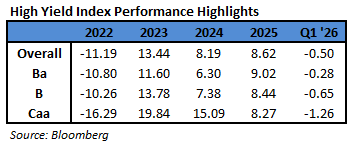
Being a more conservative asset manager, Cincinnati Asset Management does not buy CCC and lower rated securities. Additionally, our interest rate agnostic philosophy keeps us generally positioned in the five to ten year maturity timeframe. During Q1, our higher quality positioning was a benefit to performance as lower rated securities underperformed. Some performance detractors included our credit selections within the energy sector, selections within the automotive industry, and our overweight in the banking sector. Benefiting our performance this quarter were our credit selections in the communications sector and selections within the capital goods sector. Another benefit was added due to our underweight in the finance companies sector.

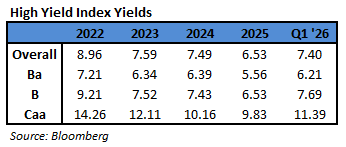
The Bloomberg US Corporate High Yield Index ended the first quarter with a yield of 7.40%. Treasury volatility, as measured by the Merrill Lynch Option Volatility Estimate (“MOVE” Index), had a spike above the 80 index average of the past 10 years, as the conflict in Iran got in full swing. The current rate of 96 is well below the spike near 200 back during the March 2023 banking scare. The most recent spike reached a high of 140 in April of 2025 as the market grappled with numerous tariff changes. Data available through February shows 4 bond defaults so far in 2026 which is relative to 16 defaults in all of 2022, 41 defaults in all of 2023, 34 defaults in all of 2024, and 32 defaults in all of 2025. The trailing twelve month dollar-weighted bond default rate is 1.60%.iv The current default rate is relative to the 1.78%, 2.06%, 1.83%, 1.52% default rates from the previous four quarter end data points listed oldest to most recent. Defaults are generally stable and the fundamentals of high yield companies are in decent shape. From a technical view, fund flows were negative this year through February data at -$2.6 billion.v No doubt there are risks, but we are of the belief that for clients that have an investment horizon over a complete market cycle, high yield deserves to be considered as part of the portfolio allocation.
The major story as the quarter closed is the Iran War and the surging price of oil. Over the past three months, oil futures have risen from $57 per barrel to over $100 per barrel and are continuing to climb as we go to print. This is not surprising as approximately 15% of the global oil supply has been disrupted. That makes this the largest oil supply shock in history. The world economy’s pain is starting to show up in business surveys conducted by S&P Global. Those surveys paint a picture of the war fallout crippling growth momentum and stoking prices higher. Here at home, Wall Street has begun to cut growth forecast and bump up inflation projections. There will certainly be plenty to evaluate as we move through 2026. Our exercise of discipline and credit selectivity is important as we continue to evaluate that the given compensation for the perceived level of risk remains appropriate. As always, we will continue our search for value and adjust positions as we uncover compelling situations. Finally, we are very grateful for the trust placed in our team to manage your capital.
This information is intended solely to report on investment strategies identified by Cincinnati Asset Management. Opinions and estimates offered constitute our judgment and are subject to change without notice, as are statements of financial market trends, which are based on current market conditions. This material is not intended as an offer or solicitation to buy, hold or sell any financial instrument. Fixed income securities may be sensitive to prevailing interest rates. When rates rise the value generally declines. Past performance is not a guarantee of future results. Gross of advisory fee performance does not reflect the deduction of investment advisory fees. Our advisory fees are disclosed in Form ADV Part 2A. Accounts managed through brokerage firm programs usually will include additional fees. Returns are calculated monthly in U.S. dollars and include reinvestment of dividends and interest. The index is unmanaged and does not take into account fees, expenses, and transaction costs. It is shown for comparative purposes and is based on information generally available to the public from sources believed to be reliable. No representation is made to its accuracy or completeness. Additional disclosures on the material risks and potential benefits of investing in corporate bonds are available on our website: https://www.cambonds.com/disclosure-statements/.
i Bloomberg March 19, 2026: Powell Says Too Soon to Judge War as Prices Keep Fed on Hold
ii Bloomberg April 1, 2026: World Interest Rate Probability
iii Bloomberg April 1, 2026: Economic Forecasts (ECFC)
iv Moody’s March 20, 2026: February 2026 Default Report and data file
v Bloomberg April 1, 2026: Fund Flows