
CAM High Yield Weekly Insights
(Bloomberg) High Yield Market Highlights
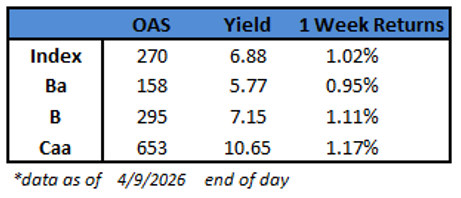
- US junk bonds rallied for a second straight session, with yields dropping to a five-week low, as a fragile ceasefire in the Middle East appeared to hold. Junk bonds are on track for a second straight week of gains.
- Gains spanned the ratings spectrum, supported by a slide in oil below $100 a barrel. The broad rally revived the primary.
- This week’s supply stands at more than $4b and April supply is over $7b
- CCC yields, the riskiest part of the high yield market, fell to a new four-week low of 10.65% on Thursday. CCCs are poised to rack up the best weekly returns since April 2025
- BB yields also fell to close at 5.77%, a new five-week low. Spreads closed at an eight-week low of 158 basis points
(Bloomberg) US CPI Surges 0.9% in Largest Monthly Jump Since 2022 on Gas
- US inflation surged in March by the most in nearly four years as the war with Iran sent gasoline prices skyrocketing.
- The consumer price index rose 0.9% from February, according to data out Friday. From a year ago, it picked up to 3.3%, the strongest pace since 2024.
- A record increase in gas prices was responsible for nearly three-quarters of the monthly advance, the Bureau of Labor Statistics said. Another measure that excludes food and energy costs increased at a slower 0.2% pace.
- The data underscore how the war in the Middle East is quickly rippling through the US economy, worsening the affordability woes many households have faced in recent years. Americans are already experiencing higher prices at the pump, and service providers including Delta Air Lines Inc. and the US Postal Service have warned of price hikes ahead.
- Even if the US-Iran truce holds and there’s a rapid resolution to the conflict, economists anticipate higher costs are likely to persist in the near term as oil output normalizes. Beyond the energy shock, a disruption in the supply of fertilizer is expected to eventually lead to higher grocery bills, while rising transportation costs could impact all kinds of consumer goods.
- The rise in consumer prices outside of energy was relatively tame in March. The prices of goods excluding food and energy, a category economists and policymakers have been watching closely to gauge the impact of tariffs, rose a modest 0.1% for a second month. Used-car prices fell for a fourth straight month.
- Grocery costs fell 0.2% on a decline in meat, dairy and egg prices. Bloomberg Economics estimates it could take as long as a year for higher fertilizer costs to impact the CPI.
- Services costs excluding energy rose 0.2% in March. Airfares rose 2.7% from February as some customers rushed to lock in prices before they jump further as the war pushes the cost of jet fuel higher. United Airlines Holdings Inc. recently warned it may have to hike prices by 20% because of the oil shock.
- Fed officials are closely tracking the impact the oil shock and the war more broadly will have on prices. Investors see little chance of another interest-rate cut in 2026 amid renewed inflation risks, according to futures, though many economists are maintaining forecasts for one or more reductions later in the year.
- Economists have lowered their growth estimates for this year on expectations that higher prices and a weaker labor market will take a toll on consumer spending. Government data out this week showed inflation-adjusted spending barely rose in February, adding to a streak of sluggish demand.
This information is intended solely to report on investment strategies identified by Cincinnati Asset Management. Opinions and estimates offered constitute our judgment and are subject to change without notice, as are statements of financial market trends, which are based on current market conditions. This material is not intended as an offer or solicitation to buy, hold or sell any financial instrument. Fixed income securities may be sensitive to prevailing interest rates. When rates rise the value generally declines. Past performance is not a guarantee of future results.